Cloud Security Threats to Watch
The biggest cloud security threats are misconfiguration, insecure APIs, account hijacking from stolen credentials, insider threats, data breaches, denial-of-service attacks, and the visibility gaps created by shadow IT. Most succeed not because the cloud platform fails, but because of customer mistakes, especially misconfiguration. Under the shared responsibility model, defending against these threats, through tight access control, encryption, continuous misconfiguration monitoring, and fast detection, is your job, and it is the difference between a safe cloud and a costly breach.
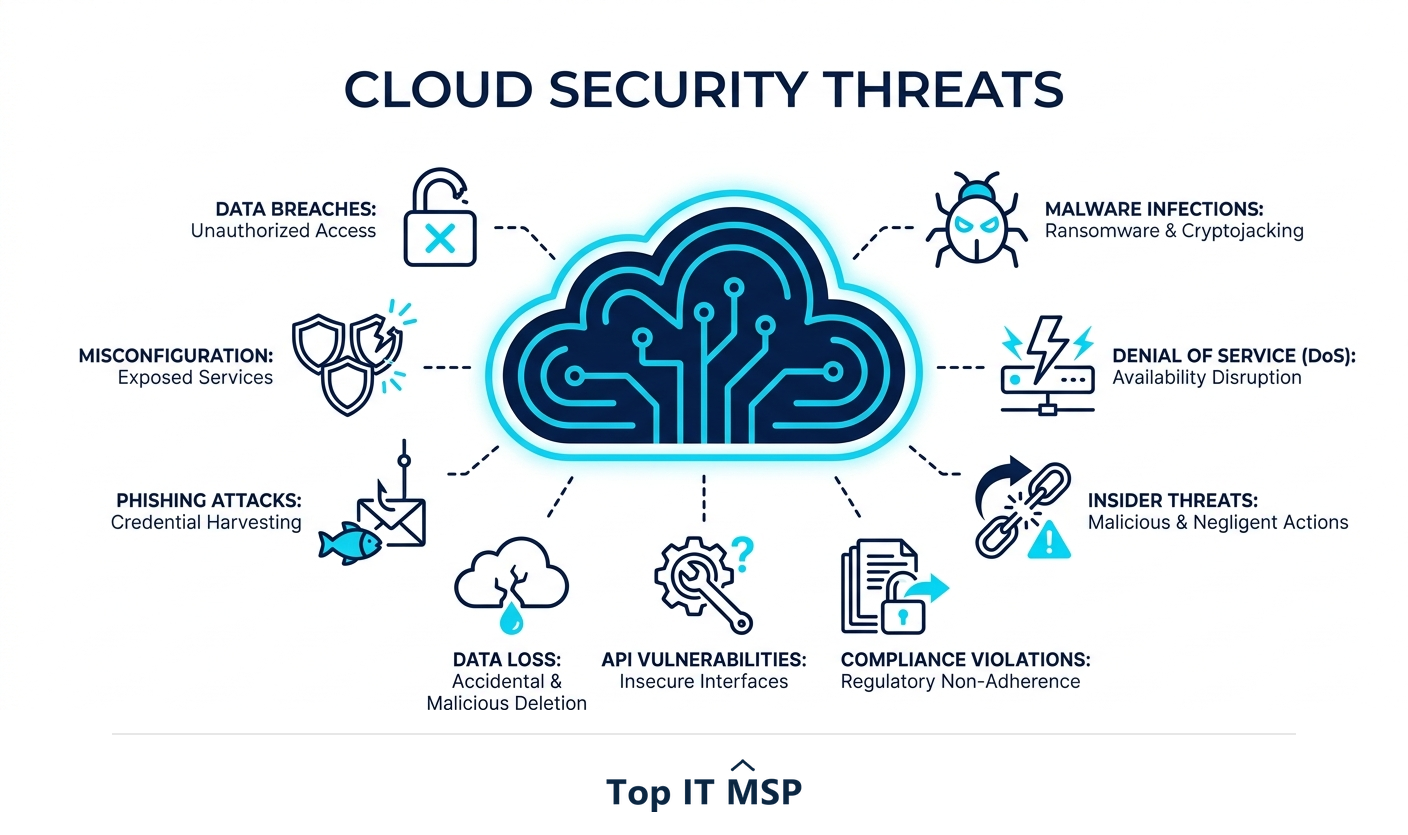
- Most cloud security threats exploit customer mistakes, not flaws in the cloud platform itself.
- Misconfiguration is the single biggest cloud threat and the leading cause of cloud data exposure.
- Stolen credentials and account hijacking remain among the most common ways attackers get in.
- The shared responsibility model puts defending against these threats squarely on the customer.
- Tight access control, encryption, continuous monitoring, and fast detection neutralize most cloud threats.
What are cloud security threats?
Cloud security threats are the risks that can compromise the data and systems you run in cloud services like AWS, Microsoft Azure, and Google Cloud. As businesses move more of their operations to the cloud, with worldwide public cloud end-user spending forecast to reach $723.4 billion in 2025, the cloud has become a primary target for attackers, and the threats have evolved to match. The uncomfortable truth is that most successful cloud attacks do not exploit some flaw in the provider's infrastructure. They exploit mistakes in how customers configure and use the cloud, which means understanding the threats clearly is the first and most important step to neutralizing them before they cause real damage.
This guide covers the leading cloud security threats, why they succeed, and how to defend against them. It pairs with our cloud security overview, our guide to data security in cloud computing, and the managed IT services hub.
Why the threats land on you: the shared responsibility model
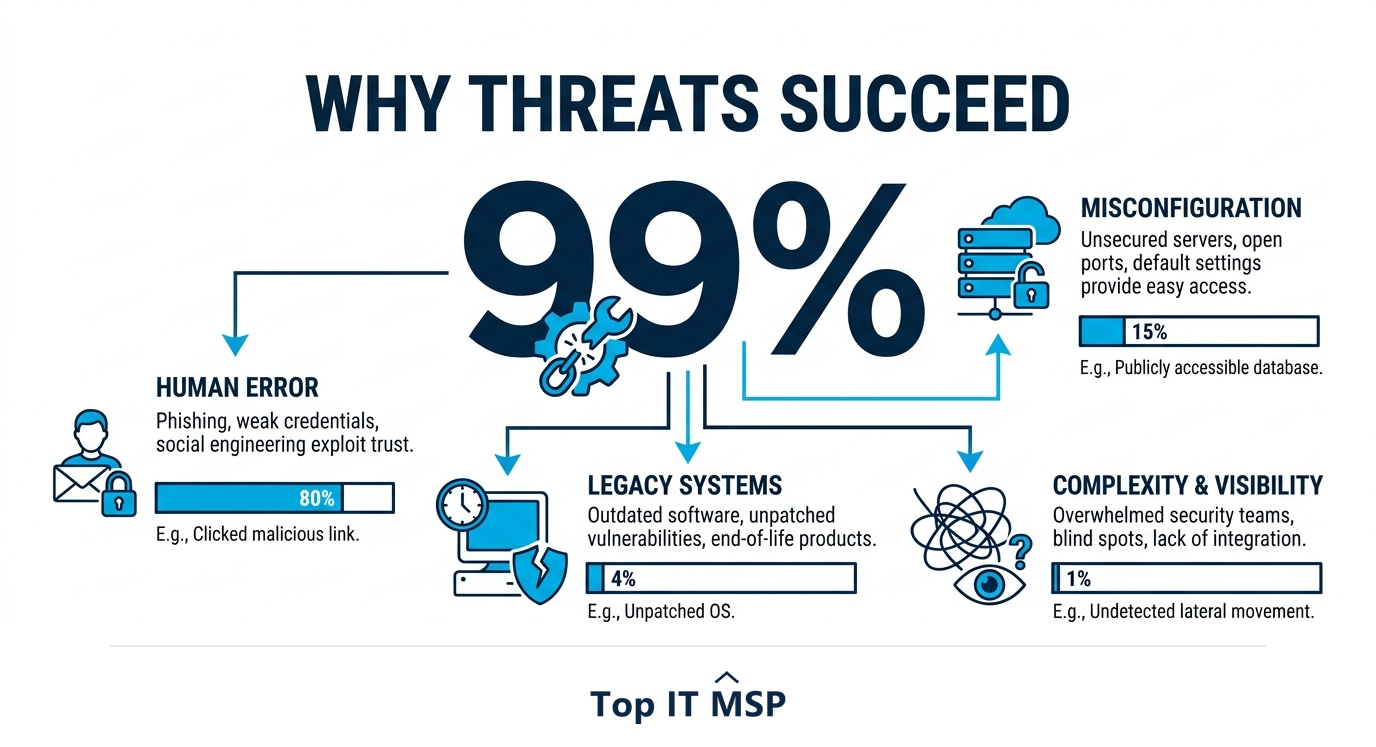
To understand cloud threats, start with the shared responsibility model. The cloud provider secures the underlying infrastructure, but you, the customer, are responsible for securing your data, identities, configurations, and access. That division is precisely why so many threats are effective: attackers go after the customer-controlled layer, where mistakes are common. Gartner has projected that through 2025, 99% of cloud security failures will be the customer's fault. In other words, the cloud is generally secure, but the way it is used often is not, and threat actors know exactly where to look.
The top cloud security threats
Most cloud incidents trace back to a recognizable set of threats:
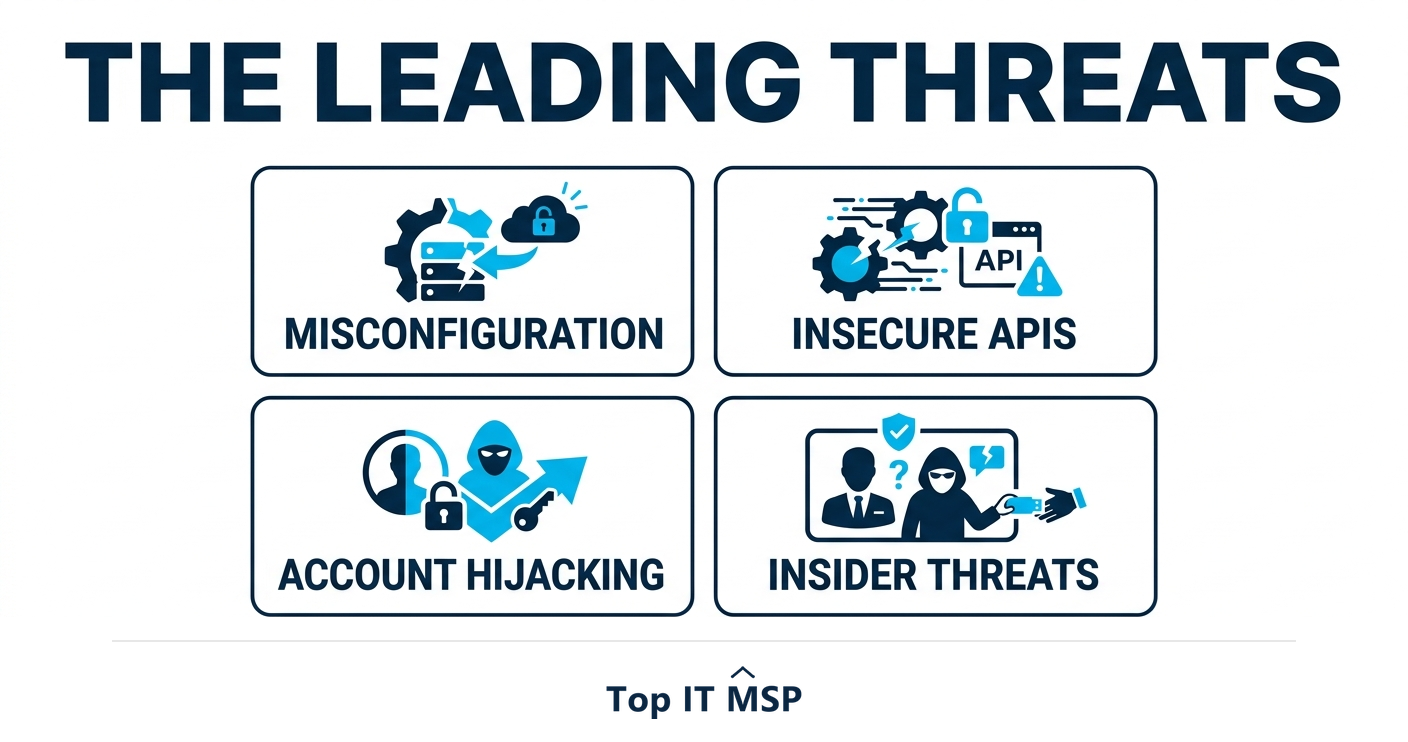
- Misconfiguration. Open storage buckets, public databases, and permissive defaults are the number-one cause of cloud data exposure, often leaving sensitive data reachable from the open internet.
- Insecure APIs. Cloud services run on APIs, and a poorly secured or unauthenticated API can hand an attacker direct access to data.
- Account hijacking. Stolen, phished, or reused credentials let attackers log in as legitimate users, which is dangerous because the human element is involved in 68% of breaches.
- Insider threats. Malicious or careless employees and contractors with legitimate access can leak or destroy data from the inside.
- Data breaches. The end result of many threats, where sensitive data is stolen or exposed, at an average cost of $4.88 million.
- Denial-of-service attacks. Flooding cloud applications with traffic to knock them offline, causing costly downtime.
- Shadow IT and lost visibility. Unsanctioned cloud services and forgotten data create blind spots no one is monitoring.
Why these threats succeed
Two underlying problems make cloud threats so effective. The first is misconfiguration at scale: cloud environments are complex and change constantly, so a single misconfigured setting, an over-permissive role, an exposed bucket, can quietly open a door that attackers exploit. The second is lost visibility: data sprawls across services and regions, and 40% of breaches involve data spread across multiple environments, so defenders often cannot see everything they are supposed to protect. When you cannot see a risk, you cannot fix it, and attackers exploit exactly those gaps. This is why breaches take so long to catch, an average of 258 days to identify and contain, giving an intruder months of undetected access.
How to defend against cloud security threats
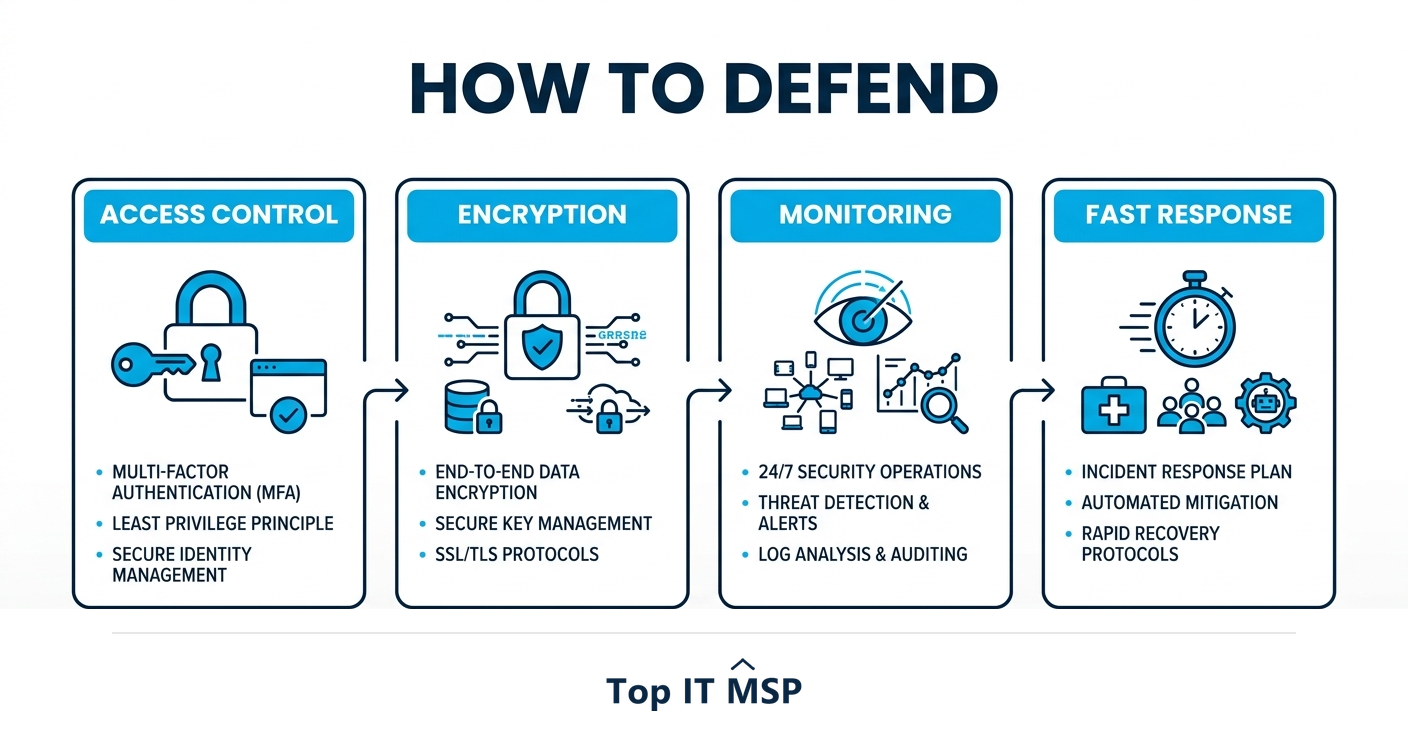
The good news is that the same short list of controls neutralizes the majority of cloud threats:
- Lock down access. Enforce least privilege, require multi-factor authentication everywhere, and review permissions regularly to shut down account hijacking, unauthorized access, and insider misuse.
- Fix misconfigurations continuously. Use cloud security posture management to detect and remediate open buckets, public resources, and risky settings before attackers find them.
- Encrypt data. Encrypt data at rest and in transit so that even a breach yields unreadable data, and manage your keys carefully.
- Secure your APIs. Authenticate, monitor, and rate-limit every API so it cannot be abused.
- Monitor and detect. Centralize logs and watch continuously so you can detect and respond fast, since speed is the biggest lever on breach cost.
- Automate response. Use automation to contain threats quickly; organizations using security automation extensively saved an average of $2.22 million per breach.
Applied together, these controls let you mitigate the realistic threats rather than chase every theoretical one.
The cost of ignoring cloud threats
Cloud threats are not abstract. A single exploited misconfiguration can expose millions of records, and the fallout, a $4.88 million average breach, downtime that costs more than $100,000 an hour, regulatory penalties, and lost trust, lands on the business, not the cloud provider. The damage is rarely limited to the initial incident, either: unauthorized access often spreads laterally from one weak point into connected systems, and recovery, notification, and remediation costs accumulate for months. This is why so many organizations bring in managed security help to watch their cloud around the clock, classify and protect sensitive data, and respond the moment something looks wrong, and why the managed services market is growing from about $330 billion in 2024 toward $879 billion over the next decade. The threats are constant and evolving; the defense has to be constant too, because attackers only need to find one unguarded door while defenders must cover them all.
Staying ahead of cloud security threats
The pattern in cloud security threats is clear: the platform rarely fails, the configuration and the people do. Defending your cloud means owning the customer side of the shared responsibility model with discipline, locking down access, fixing misconfigurations continuously, encrypting data, securing APIs, and monitoring everything so you detect trouble in minutes rather than months. Get those fundamentals right and you remove the foothold nearly every cloud threat depends on. Learn more in our cloud security guide.
If you want help defending your cloud against these threats, comparing vetted providers on merit is the place to start. Browse merit-ranked managed IT and security firms by city in the Top IT MSP directory, where ranking is earned on rating and verified data, not on who pays the most.
Frequently asked questions
What are the biggest cloud security threats?
The biggest cloud security threats are misconfiguration (open buckets and permissive defaults), insecure APIs, account hijacking from stolen credentials, insider threats, data breaches, denial-of-service attacks, and the visibility gaps created by shadow IT. Misconfiguration is the single largest threat and the leading cause of cloud data exposure.
Why are cloud security threats so effective?
Because most exploit the customer-controlled layer of the cloud, not the provider's infrastructure. Cloud environments are complex and change constantly, so misconfigurations are common, and data sprawls across services, creating visibility gaps. Gartner projects 99% of cloud security failures are the customer's fault through 2025, and attackers know exactly where those gaps tend to be.
Who is responsible for cloud security threats?
Under the shared responsibility model, the cloud provider secures the underlying infrastructure, but the customer is responsible for securing their data, identities, configurations, and access. Most cloud threats target the customer layer, so defending against them, and the consequences when they succeed, falls primarily on the business, not the provider.
How do you defend against cloud security threats?
Enforce least-privilege access with multi-factor authentication, continuously detect and fix misconfigurations with cloud security posture management, encrypt data at rest and in transit, secure and monitor your APIs, centralize logging for fast detection and response, and automate containment. Together these controls neutralize the majority of realistic cloud threats.
Is misconfiguration really the top cloud threat?
Yes. Misconfiguration, such as open storage buckets, public databases, and over-permissive roles, is consistently the leading cause of cloud data exposure. It is why Gartner attributes 99% of cloud security failures to the customer through 2025, and why continuous misconfiguration monitoring is one of the highest-value cloud defenses you can deploy.
How long does it take to detect a cloud breach?
Too long. Across all environments, breaches take an average of 258 days to identify and contain, giving an intruder months of undetected access. Cloud visibility gaps make this worse, which is why continuous monitoring and fast detection and response are the single biggest levers for reducing both the likelihood and the cost of a cloud breach.
Related reading
Defend your cloud against modern threats
Top IT MSP is the independent directory of vetted managed IT and security providers across North America. Compare merit-ranked firms in your city that monitor and secure cloud environments around the clock. No pay-to-play.
Top IT MSP is an independent directory that connects you with vetted managed IT providers. Browse the directory city by city:
- Managed IT Services in Phoenix
- Managed IT Services in Atlanta
- Managed IT Services in Philadelphia
- Managed IT Services in New York
- Managed IT Services in Lafayette
- Managed IT Services in Las Vegas
- Managed IT Services in Lexington
- Managed IT Services in Lincoln
- Managed IT Services in Louisville
- Managed IT Services in Madison