Application Modernization: A Practical Guide
Application modernization is the process of updating legacy applications to run better on modern, often cloud-based, technology, instead of replacing them wholesale. The main approaches range from a simple rehost (lift and shift) to replatforming, refactoring, rearchitecting into microservices, rebuilding, and replacing. A good strategy assesses each application, prioritizes by business value and risk, and modernizes in phases. Done well it cuts cost and technical debt, improves security and scalability, and unblocks innovation, but it has to be planned and executed carefully.
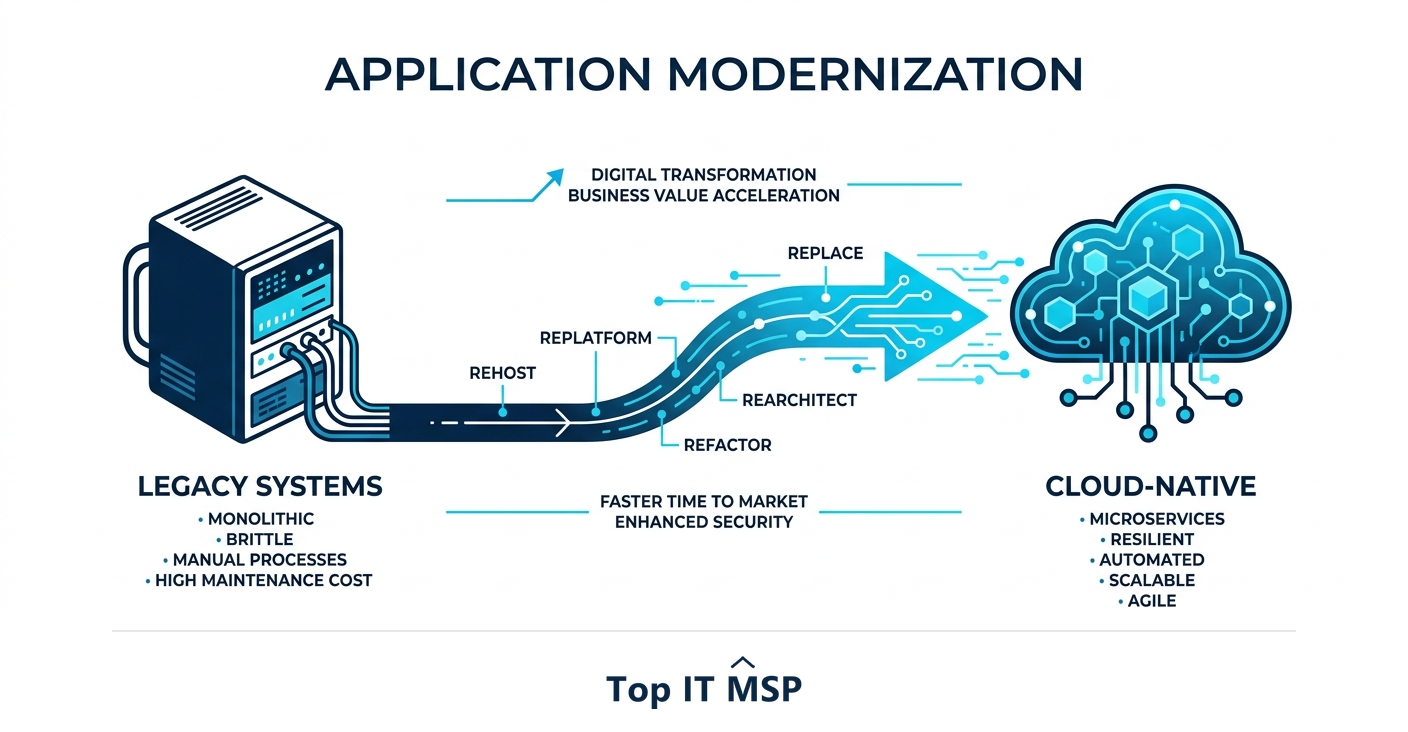
- Application modernization updates legacy applications to run on modern, usually cloud-based, technology.
- The seven common approaches range from rehosting (lift and shift) to refactoring, rearchitecting, and rebuilding.
- A sound strategy assesses every application, prioritizes by value and risk, and modernizes in phases.
- Modernization cuts technical debt and cost, and improves security, reliability, and scalability.
- The biggest risks are scope, cost, and disruption, which is why most businesses modernize with expert help.
What is application modernization?
Application modernization is the process of updating older software, your legacy applications, so they run better on modern, usually cloud-based, technology. Rather than ripping out and replacing a system that still does its job, modernization improves how that application is built, hosted, and maintained, so it becomes faster, safer, cheaper to run, and easier to change. The classic target is a monolithic application running on aging on-premises servers that has become slow to update and expensive to keep alive. Modernization moves it toward modern, cloud-native patterns. It is a core part of digital transformation, and it is happening at scale as businesses migrate to the cloud, with worldwide public cloud end-user spending forecast to reach $723.4 billion in 2025.
This guide explains what application modernization involves, the main approaches you can take, how to build a strategy, the benefits, and the challenges to avoid. It pairs with our digital transformation overview and the managed IT services hub.
Why modernize legacy applications?
Legacy systems do not just age gracefully in the background; they accumulate real cost and risk. Older applications get harder and more expensive to maintain as the people who understand them retire and the platforms they run on fall out of support. They are often less secure, because unsupported software stops receiving patches, and that matters when the average data breach costs $4.88 million and 40% of breaches involve data spread across multiple environments. They are also more fragile, and unplanned downtime is expensive, costing most organizations more than $100,000 an hour. On top of that, legacy applications are slow to change, which holds the business back when it needs to move quickly. This drag is what teams mean by technical debt, the accumulated cost of putting off modernization.
The main application modernization approaches
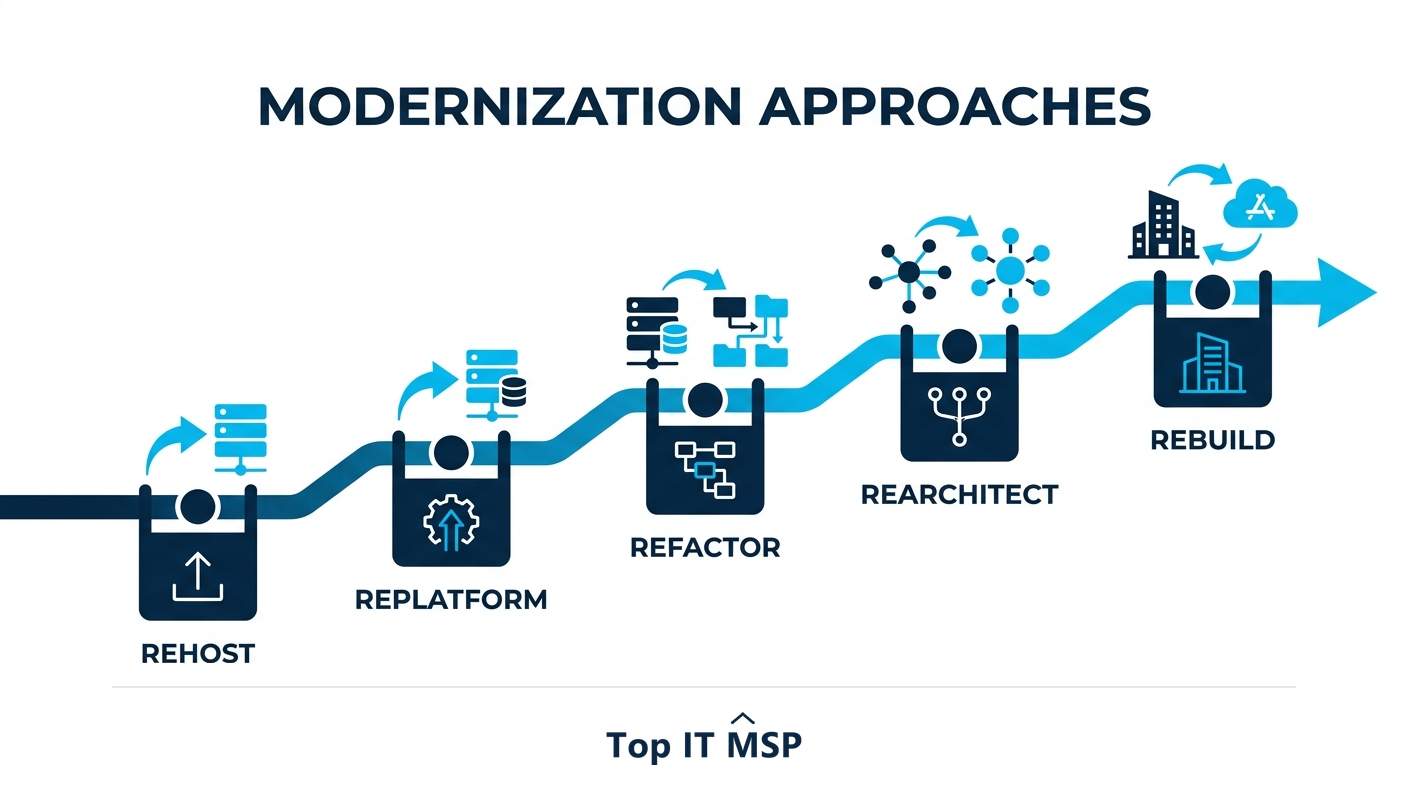
There is no single way to modernize. The right approach for each application depends on its value, its condition, and your goals. The common options, often called the seven Rs, run from least to most effort:
- Rehost (lift and shift). Move the application to the cloud as-is, with minimal change. The fastest option, used to rehost quickly and capture cloud cost and reliability benefits before deeper work.
- Replatform. Make targeted changes during the move, such as switching to a managed database, without rewriting the core. A pragmatic middle path.
- Refactor. Restructure the existing code to run better in the cloud and reduce technical debt, while keeping its external behavior the same.
- Rearchitect. Change the application's structure more deeply, for example breaking a monolithic app into microservices so parts can scale and deploy independently.
- Rebuild. Rewrite the application from scratch using modern, cloud-native technology while preserving its scope.
- Replace. Retire the application and adopt a commercial off-the-shelf or SaaS product instead.
- Retain or retire. Keep some applications as-is for now, and decommission others that are no longer needed.
How to build a modernization strategy
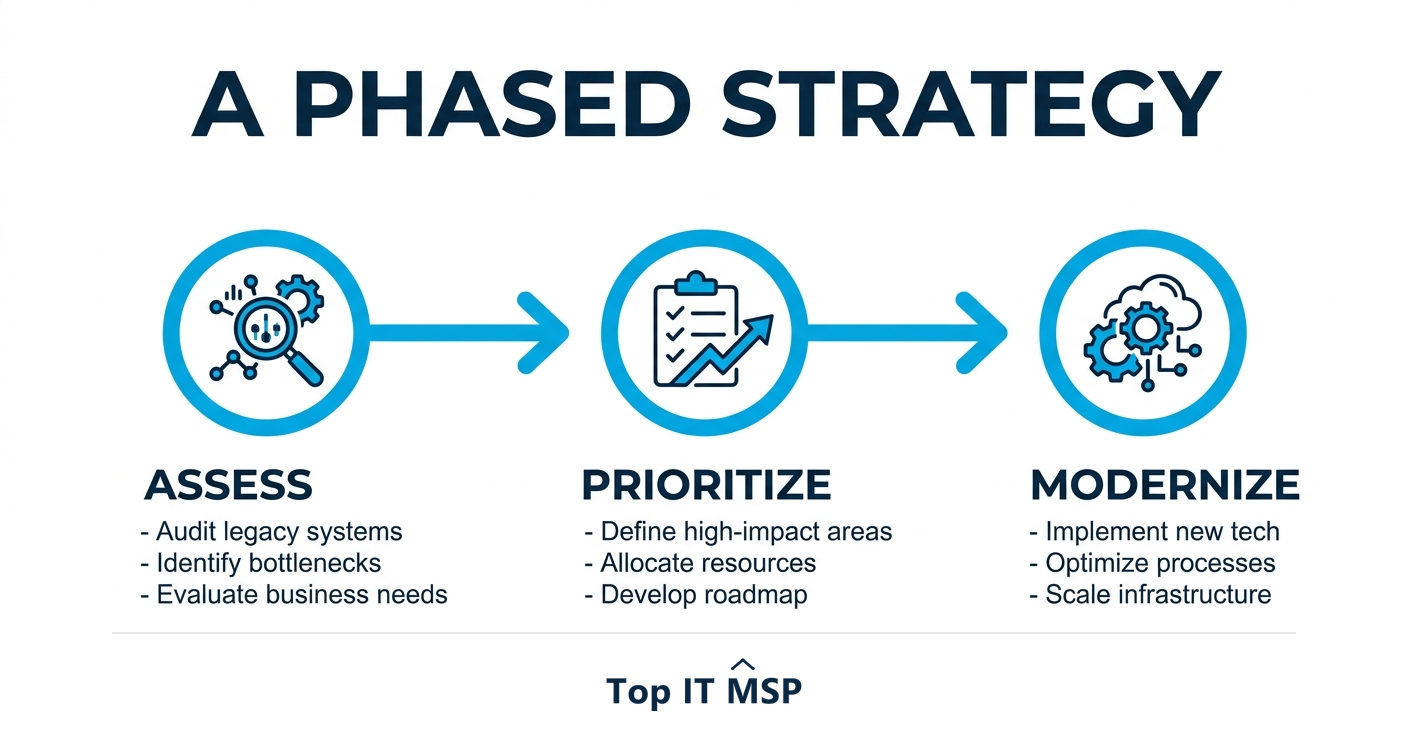
The biggest mistakes in modernization come from skipping the planning. A sound strategy follows three steps. First, assess: inventory your applications and understand each one's business value, technical condition, dependencies, and cost to run. Second, prioritize: rank applications by the value of modernizing them against the risk and effort involved, so you start where the payoff is clearest, often a costly, fragile, or insecure system. Third, modernize in phases: pick the right approach for each application and migrate in manageable waves rather than attempting a risky big-bang cutover. This lets you learn, show value early, and contain risk.
Throughout, modernize securely. The cloud you are moving to rewards good configuration and punishes bad, since Gartner projects that through 2025, 99% of cloud security failures will be the customer's fault. Building security in from the assessment stage is far cheaper than bolting it on after a breach that takes an average of 258 days to identify and contain.
The benefits of application modernization
When it is done well, modernization pays for itself across several dimensions:
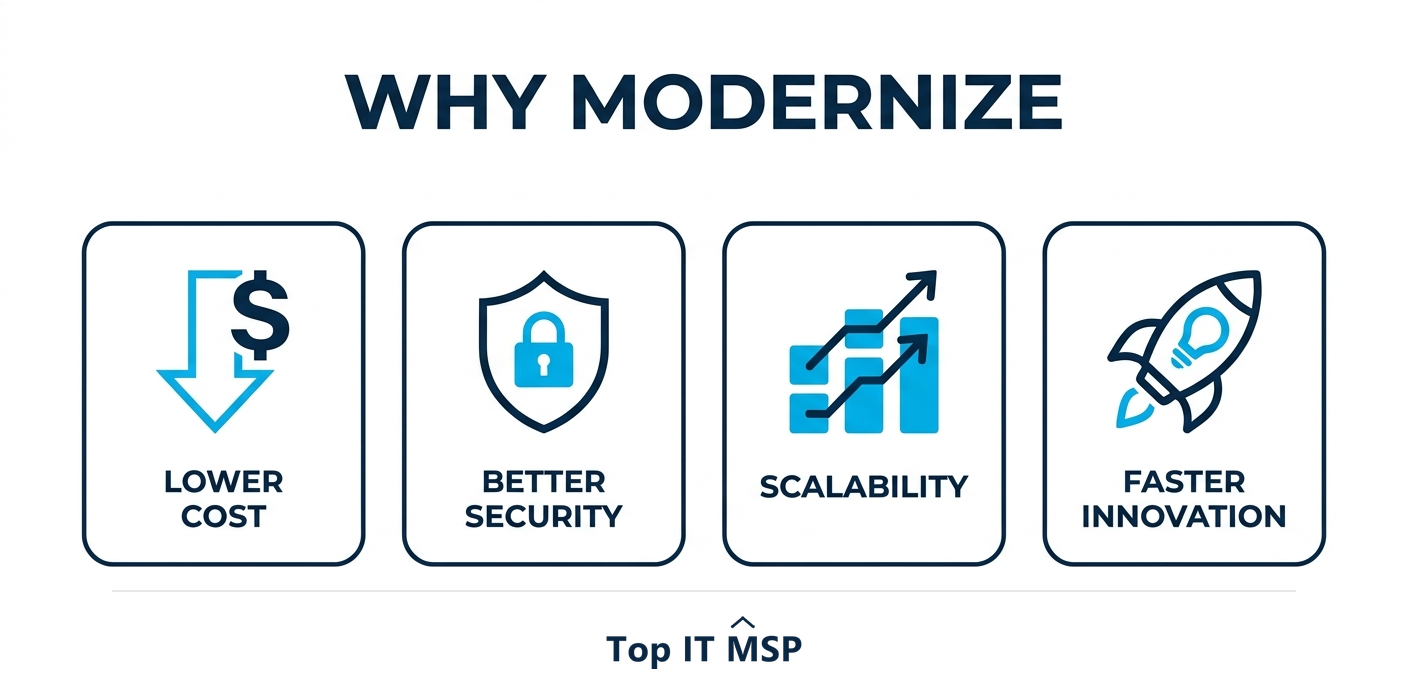
- Lower cost. Modern, cloud-hosted applications cost less to run and maintain than aging on-premises systems, and you stop paying down technical debt.
- Better security. Supported, modern platforms get patched, and cloud-native applications can use built-in encryption, monitoring, and access controls to stay secure.
- Scalability. Cloud-native and microservices designs are inherently scalable and scale on demand, so the application grows with the business instead of buckling under load.
- Reliability. Redundant cloud infrastructure means less downtime than a single aging server room.
- Faster innovation. Modern, modular applications are far easier and quicker to change, so the business can ship new features and respond to the market faster.
- Automation gains. Modern platforms unlock automation, and extensive use of security automation alone saved breached organizations an average of $2.22 million.
Common challenges and how to avoid them
Modernization projects fail for predictable reasons, and each is avoidable. Underestimating scope and cost is the most common, which is why a phased approach with a clear assessment up front matters so much. Business disruption is another risk, mitigated by migrating in waves and testing thoroughly before each cutover. Lost institutional knowledge, where no one fully understands how the legacy application works, calls for careful discovery before you touch the code. And skills gaps are real, because modernization needs cloud, security, and architecture expertise that many internal teams do not have on staff. That last point is why the managed services market is growing from about $330 billion in 2024 toward $879 billion over the next decade: businesses increasingly bring in partners who modernize for a living.
Getting application modernization right
Application modernization is not about chasing the newest technology for its own sake. It is about deliberately reducing the cost, risk, and drag of legacy systems so your technology helps the business move faster instead of holding it back. Start by assessing what you have, prioritize the applications where modernizing delivers the most value, choose the right approach for each, and execute in phases with security built in. Most organizations get there fastest with a partner who has done it before. Learn more in our digital transformation guide and our cloud security overview.
If you want help planning or executing an application modernization program, comparing vetted providers on merit is the place to start. Browse merit-ranked managed IT firms by city in the Top IT MSP directory, where ranking is earned on rating and verified data, not on who pays the most.
Frequently asked questions
What is application modernization?
Application modernization is the process of updating legacy applications so they run better on modern, usually cloud-based, technology. Instead of replacing a working system wholesale, modernization improves how it is built, hosted, and maintained, making it faster, more secure, cheaper to run, and easier to change. It is a core part of digital transformation.
What are the approaches to application modernization?
The common options, often called the seven Rs, run from least to most effort: rehost (lift and shift to the cloud as-is), replatform (targeted changes during the move), refactor (restructure the code), rearchitect (for example, break a monolith into microservices), rebuild (rewrite using modern technology), replace (adopt an off-the-shelf product), and retain or retire. The right choice depends on each application's value and condition.
Why is application modernization important?
Legacy applications accumulate cost and risk: they get more expensive to maintain, less secure as they fall out of support, more fragile and prone to costly downtime, and slow to change. Modernization reduces this technical debt, improves security and reliability, and lets the business move faster, which is increasingly essential as competitors operate on modern, cloud-native platforms.
How do you create an application modernization strategy?
Follow three steps. Assess: inventory your applications and understand each one's business value, technical condition, dependencies, and cost. Prioritize: rank applications by the value of modernizing them against risk and effort, starting where the payoff is clearest. Modernize in phases: pick the right approach per application and migrate in manageable waves rather than a risky big-bang cutover, with security built in from the start.
What are the benefits of modernizing legacy applications?
Modernization lowers the cost of running and maintaining applications, improves security through supported and cloud-native platforms, adds on-demand scalability, increases reliability through redundant cloud infrastructure, and speeds up innovation because modern, modular applications are far easier to change. It also unlocks automation that reduces both effort and risk.
What are the biggest risks in an application modernization project?
The biggest risks are underestimating scope and cost, business disruption during cutover, lost institutional knowledge about how legacy systems work, and internal skills gaps in cloud, security, and architecture. Each is avoidable with a thorough up-front assessment, a phased rollout with testing, careful discovery, and, for many businesses, an experienced modernization partner.
Related reading
Modernize your applications with confidence
Top IT MSP is the independent directory of vetted managed IT providers across North America. Compare merit-ranked firms in your city that plan and execute application modernization and cloud migration. No pay-to-play.
Top IT MSP is an independent directory that connects you with vetted managed IT providers. Browse the directory city by city:
- Managed IT Services in Philadelphia
- Managed IT Services in New York
- Managed IT Services in Los Angeles
- Managed IT Services in Chicago
- Managed IT Services in Fort Worth
- Managed IT Services in Gilbert
- Managed IT Services in Glendale
- Managed IT Services in Grand Rapids
- Managed IT Services in Greensboro
- Managed IT Services in Greenville