What Is a Managed Service Provider (MSP)?
A managed service provider (MSP) is a company that remotely manages a business's IT, support, monitoring, security, and infrastructure, as an ongoing service for a predictable monthly fee. Instead of calling for help only when something breaks, you get proactive monitoring, a staffed help desk, cybersecurity, and IT strategy from an outside team. The MSP model replaced the old break-fix approach because preventing problems is cheaper than fixing them. For most small and midsize businesses, an MSP delivers a full IT department's capability at a fraction of the cost.
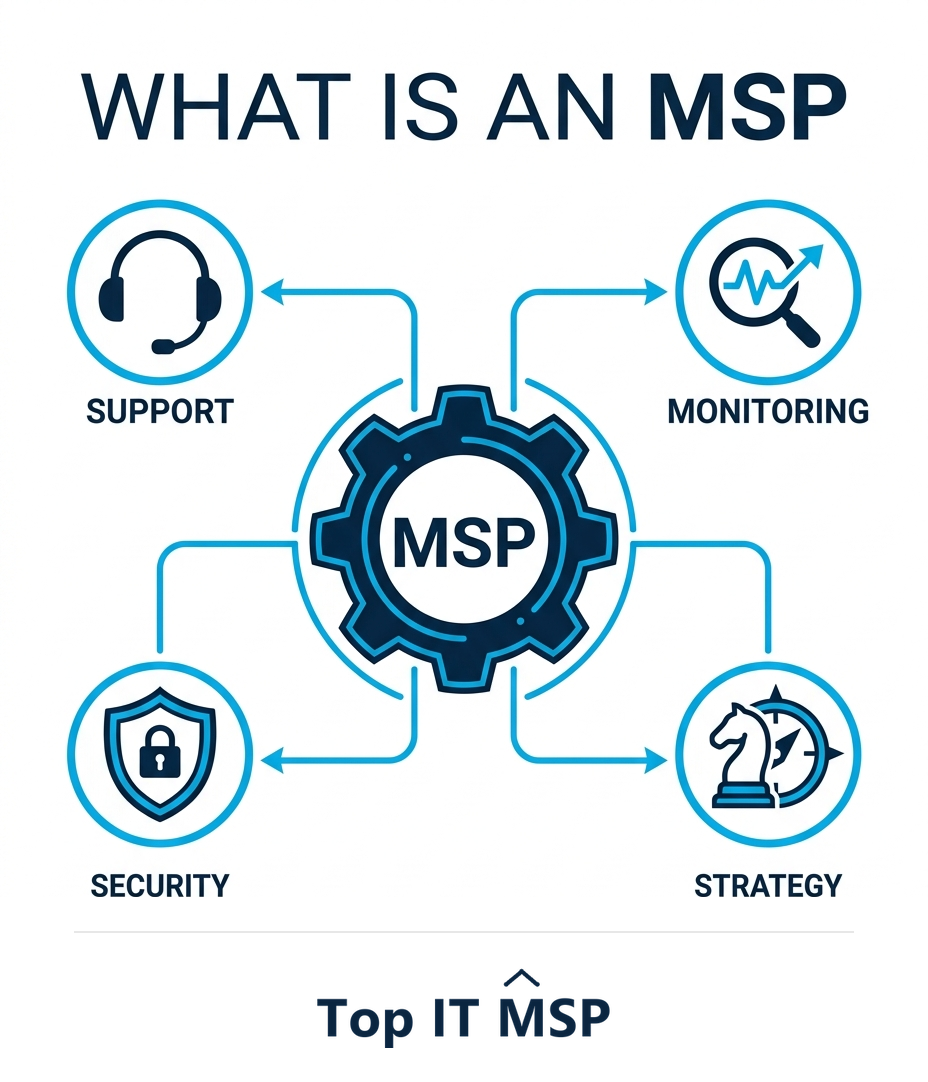
- An MSP manages a business's IT as an ongoing service for a predictable monthly fee.
- Core services include help desk, proactive monitoring, cybersecurity, cloud management, and IT strategy.
- The MSP model is proactive, preventing problems, where the older break-fix model only reacted to them.
- An MSP focuses on all of IT; an MSSP specializes specifically in security, and many providers do both.
- For most small and midsize businesses, an MSP delivers a full IT department's capability affordably.
What is a managed service provider?
A managed service provider, or MSP, is a company that takes over the ongoing management of another business's IT. Rather than employing your own technicians or calling someone only when a computer breaks, you hand responsibility for supporting, monitoring, securing, and maintaining your technology to an outside specialist, who delivers it as a continuous service for a predictable monthly fee. In plain terms, an MSP is an outsourced IT department: the same help desk, monitoring, cybersecurity, and strategy a large company gets from its internal team, delivered as a service to businesses that cannot or do not want to build that team themselves. The model has become the standard way small and midsize businesses run their technology.
This guide explains what an MSP is, what it does, how the model works, how it differs from break-fix and from an MSSP, and how to choose one. It pairs with our managed IT services hub and the IT support services page.
What does an MSP do?
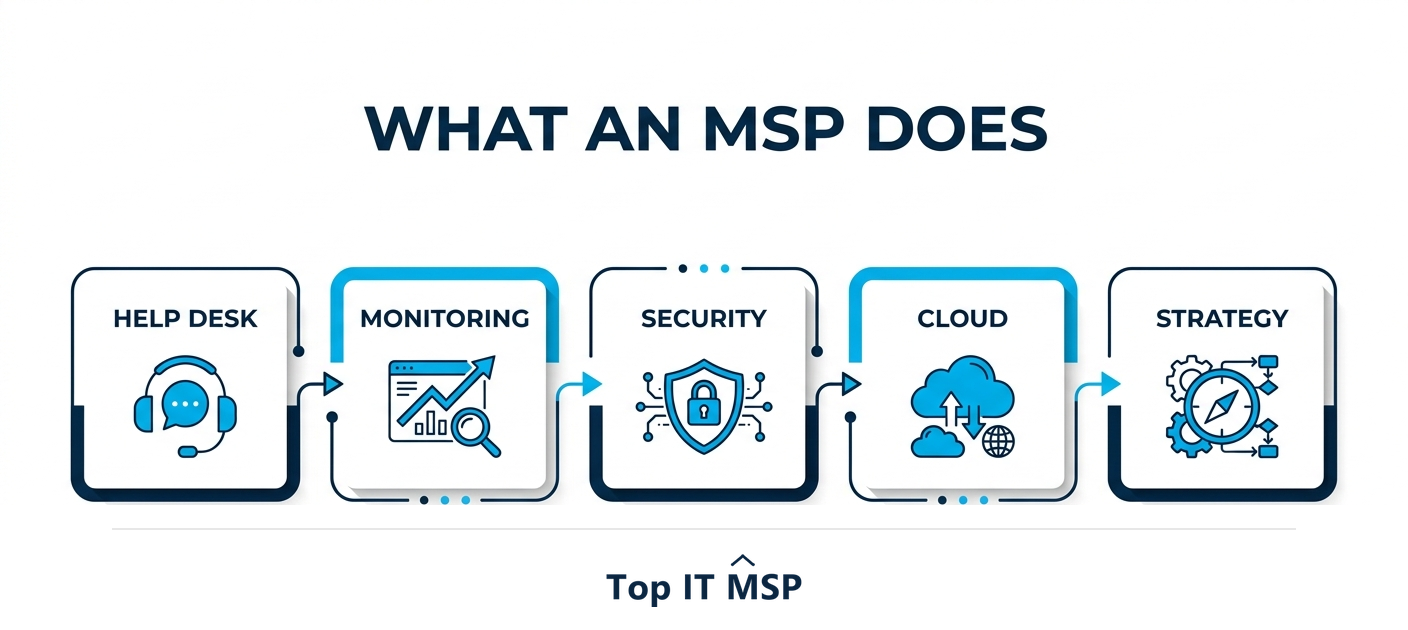
A full-service MSP handles the breadth of a business's technology needs, typically including:
- Help desk and end-user support. Day-to-day help for staff when something is not working.
- Proactive monitoring and maintenance. Watching systems around the clock to catch and fix issues before they cause downtime, plus patching and updates.
- Cybersecurity. Firewalls, endpoint protection, email security, and monitoring to defend the business against threats.
- Cloud and infrastructure management. Running and securing servers, networks, and cloud services like Microsoft 365.
- Backup and disaster recovery. Ensuring data is backed up and recoverable after an incident.
- IT strategy and vCIO guidance. Helping plan technology investments so IT supports the business's goals, not just its day-to-day.
The exact mix varies, but the throughline is that an MSP owns the outcome, keeping your technology working, secure, and improving, rather than just performing isolated tasks.
How the MSP model works
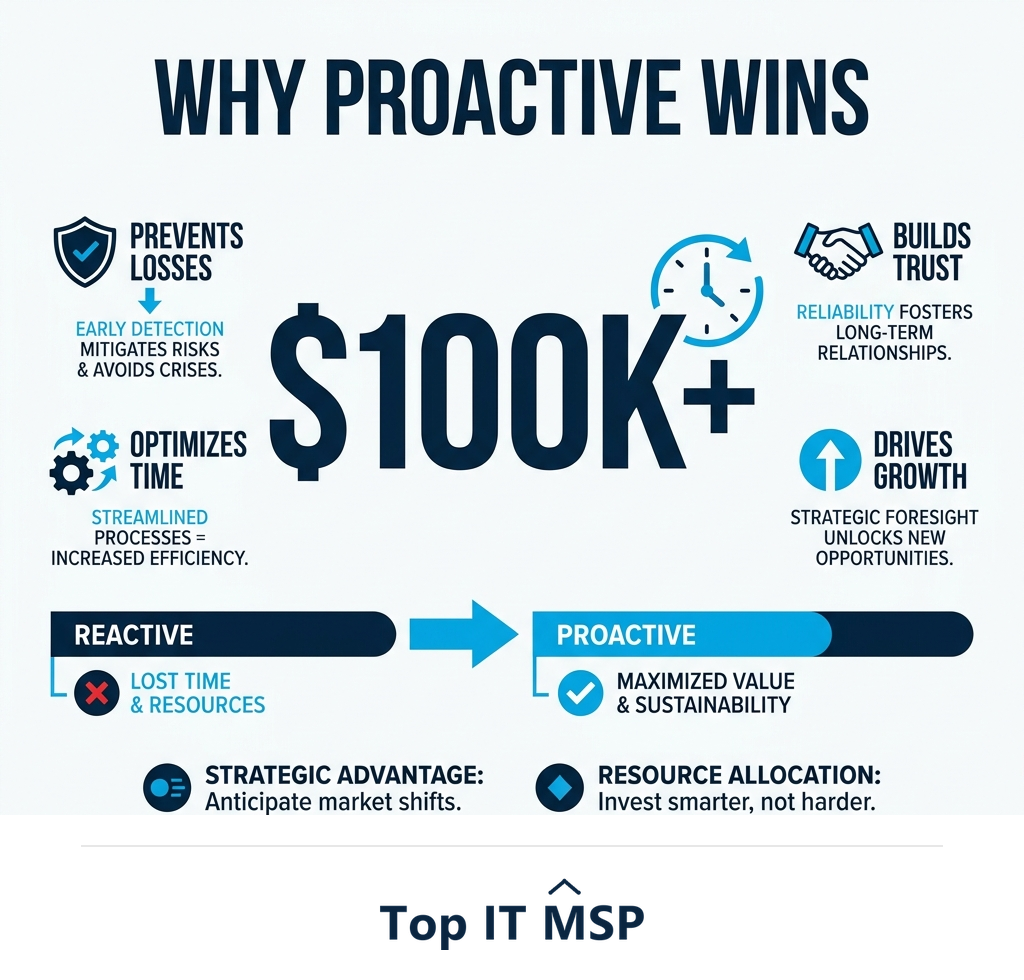
What makes an MSP different from older IT help is the model. An MSP works proactively, using remote monitoring and management tools to watch your systems continuously and resolve many issues before you even notice them. The relationship is governed by a service-level agreement (SLA) that spells out response and resolution times, so support is accountable rather than ad hoc. And you pay a predictable, usually per-user or per-device, monthly fee, which turns IT from an unpredictable cost into a flat operating expense. This proactive, subscription approach aligns the MSP's incentives with yours: because they are paid a flat fee, preventing problems is in their interest, not billing you for every fire they put out. The model's value shows up in numbers like the cost of downtime, more than $100,000 an hour for most organizations, which proactive monitoring is designed to avoid.
MSP vs break-fix
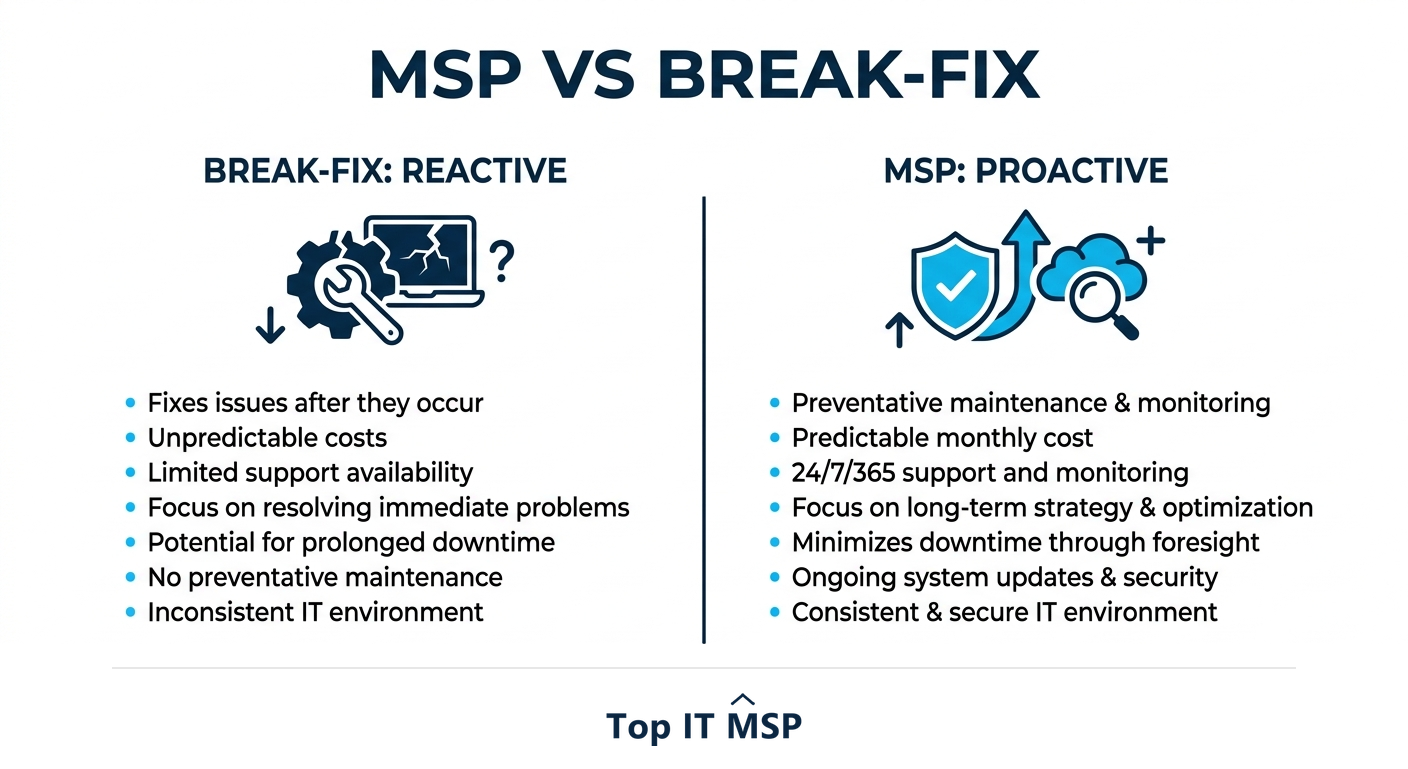
Before the MSP model, most small businesses used break-fix IT: you called a technician when something broke and paid by the hour to fix it. The problem is that break-fix is purely reactive, the provider only makes money when things go wrong, and you discover problems only after they have already caused disruption. The MSP model flips this. By monitoring proactively and maintaining systems continuously for a flat fee, an MSP prevents many problems entirely and catches others early. For a business that depends on its technology, proactive prevention is almost always cheaper and less disruptive than reactive repair, which is why the industry shifted decisively to managed services, a market now growing from about $330 billion in 2024 toward $879 billion over the next decade.
MSP vs MSSP
A related term is MSSP, or managed security services provider. The difference is focus. An MSP manages all of a business's IT, with security as one part of the job. An MSSP specializes specifically in cybersecurity, with deeper security expertise and a dedicated security operations center. As threats have grown, the line has blurred, many MSPs now deliver strong security or MSSP-level services, and many businesses prefer one provider for both IT and security. This matters because the average data breach costs $4.88 million, the human element is involved in 68% of breaches, and security talent is scarce amid a global shortfall of about 4.8 million cybersecurity professionals. Whether you choose an MSP, an MSSP, or one that does both, make sure security depth is real. For more, see our guide to what an MSSP is.
The benefits of using an MSP
The advantages explain why the model is so popular:
- Access to a full team. Broad, specialized expertise you could not afford to hire across networking, cloud, and security.
- Predictable cost. A flat monthly fee instead of unpredictable salaries plus emergency repairs.
- 24/7 coverage. Round-the-clock monitoring and response that a small internal team cannot match.
- Better security. Enterprise-grade tools and monitoring, with automation that saves breached organizations an average of $2.22 million.
- Faster resolution. Proactive maintenance and quick response, which matters when breaches take an average of 258 days to identify and contain.
- Strategic guidance. An expert partner to help plan technology around your business goals.
How to choose an MSP
MSPs vary widely, so choose carefully. Look for clear, written service-level agreements with real response and resolution commitments; genuine cybersecurity depth and 24/7 monitoring; experience with businesses your size and industry; transparent, predictable pricing; and strong, verifiable references and ratings. Ask how they monitor and respond, who actually does the work, and how they would handle a breach or major outage. Because security and IT are intertwined, consider whether you want one provider for both. The label matters less than the fit and the track record.
If you are evaluating managed service providers, comparing them on merit is the place to start. Browse merit-ranked MSPs by city in the Top IT MSP directory, where ranking is earned on rating and verified data, not on who pays the most. You can also compare the models in our guide to managed IT vs in-house IT.
Frequently asked questions
What is a managed service provider (MSP)?
A managed service provider (MSP) is a company that manages a business's IT, support, monitoring, security, and infrastructure, as an ongoing service for a predictable monthly fee. Rather than calling for help only when something breaks, you get proactive monitoring, a staffed help desk, cybersecurity, and IT strategy from an outside team. In effect, an MSP is an outsourced IT department.
What does an MSP do?
A full-service MSP provides help desk and end-user support, proactive monitoring and maintenance, cybersecurity, cloud and infrastructure management, backup and disaster recovery, and IT strategy. The mix varies, but the defining feature is that an MSP owns the outcome of keeping your technology working, secure, and improving, rather than just performing isolated repairs.
What is the difference between an MSP and break-fix IT?
Break-fix IT is reactive: you call a technician when something breaks and pay by the hour to fix it. The MSP model is proactive: for a flat monthly fee, the provider monitors and maintains your systems continuously, preventing many problems and catching others early. Proactive prevention is usually cheaper and less disruptive than reactive repair, which is why most businesses moved to the MSP model.
What is the difference between an MSP and an MSSP?
An MSP manages all of a business's IT, with security as one part. An MSSP (managed security services provider) specializes specifically in cybersecurity, with deeper security expertise and a dedicated security operations center. The line has blurred as many MSPs now offer strong security, and many businesses prefer a single provider for both IT and security.
How does MSP pricing work?
Most MSPs charge a predictable monthly fee, typically per user or per device, that covers help desk, monitoring, maintenance, and core security. This turns IT from an unpredictable cost into a flat operating expense. Some services, such as major projects or premium security, may be priced separately, so confirm what is and is not included before signing.
How do I choose the right MSP?
Look for clear written service-level agreements with real response and resolution times, genuine cybersecurity depth and 24/7 monitoring, experience with businesses your size and industry, transparent predictable pricing, and strong verifiable references and ratings. Ask who does the work and how they handle breaches and outages. The fit and track record matter more than the provider's size or marketing.
Related reading
Find the right managed service provider
Top IT MSP is the independent directory of vetted managed service providers across North America. Compare merit-ranked MSPs in your city on rating and verified data. No pay-to-play.
Top IT MSP is an independent directory that connects you with vetted managed IT providers. Browse the directory city by city:
- Managed IT Services in Chicago
- Managed IT Services in Houston
- Managed IT Services in Dallas
- Managed IT Services in Phoenix
- Managed IT Services in Denver
- Managed IT Services in Detroit
- Managed IT Services in Edmonton
- Managed IT Services in El Paso
- Managed IT Services in Etobicoke
- Managed IT Services in Eugene