Types of Cloud Computing Explained
Cloud computing comes in two kinds of types. Deployment models describe who owns the infrastructure: public, private, hybrid, and multi-cloud. Service models describe how much the provider manages: IaaS (you manage most), PaaS (provider manages the platform), and SaaS (provider manages everything). Most businesses use a mix, and understanding both dimensions is the key to choosing what fits each workload.
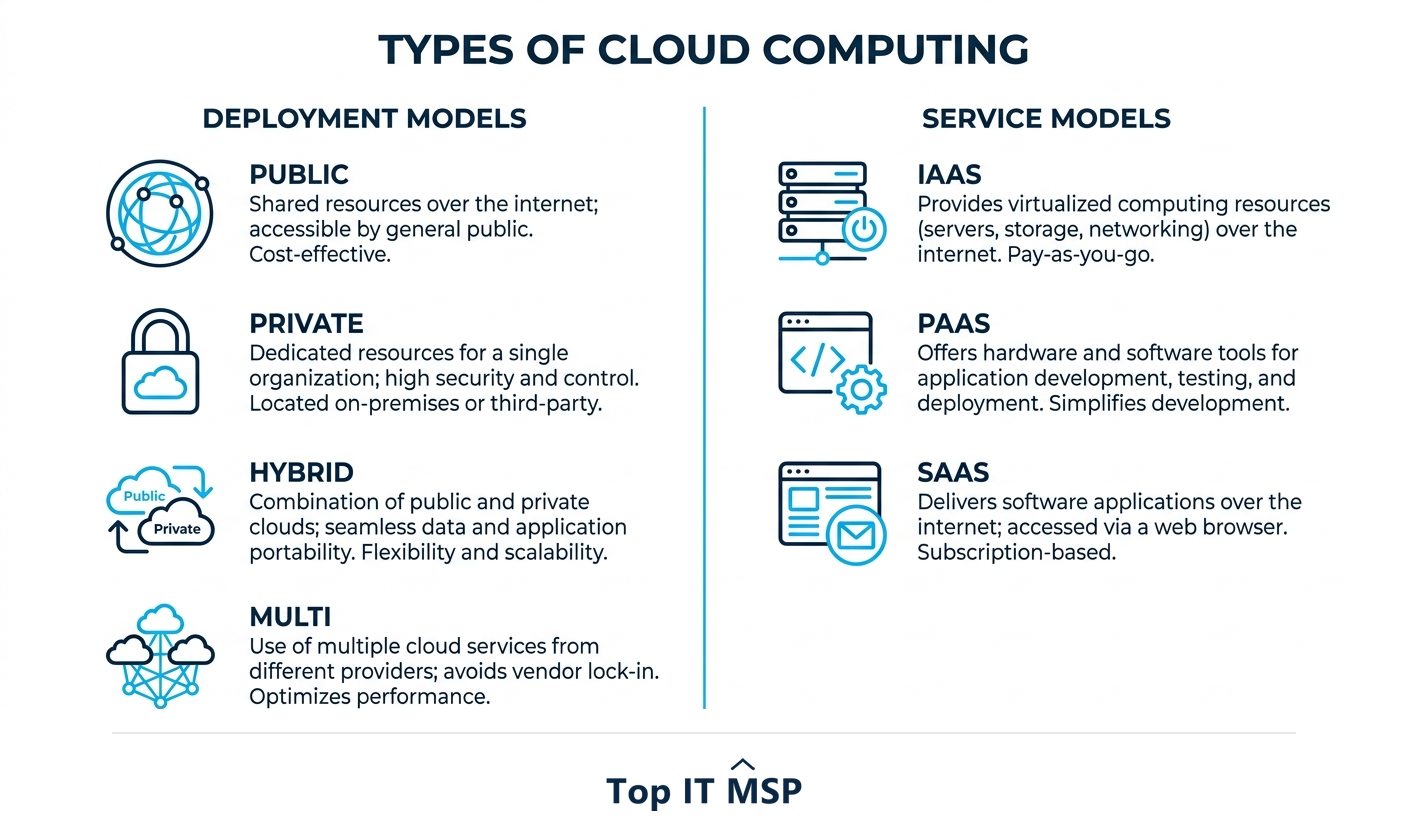
- Cloud computing types fall into two dimensions: deployment models and service models.
- Deployment models, public, private, hybrid, and multi-cloud, describe who owns and shares the infrastructure.
- Service models, IaaS, PaaS, and SaaS, describe how much the provider manages versus you.
- SaaS manages everything for you; IaaS gives you the most control and responsibility.
- Most businesses combine several types, choosing the right model for each workload.
Two ways to classify cloud computing
When people ask about the types of cloud computing, they are usually mixing two different questions, and separating them clears up most of the confusion. The first question is about deployment models: who owns and shares the underlying infrastructure. The second is about service models: how much of the technology stack the provider manages versus how much you manage. Every cloud setup is a combination of one deployment model and one or more service models, so understanding both dimensions is what lets you choose the right fit for each workload.
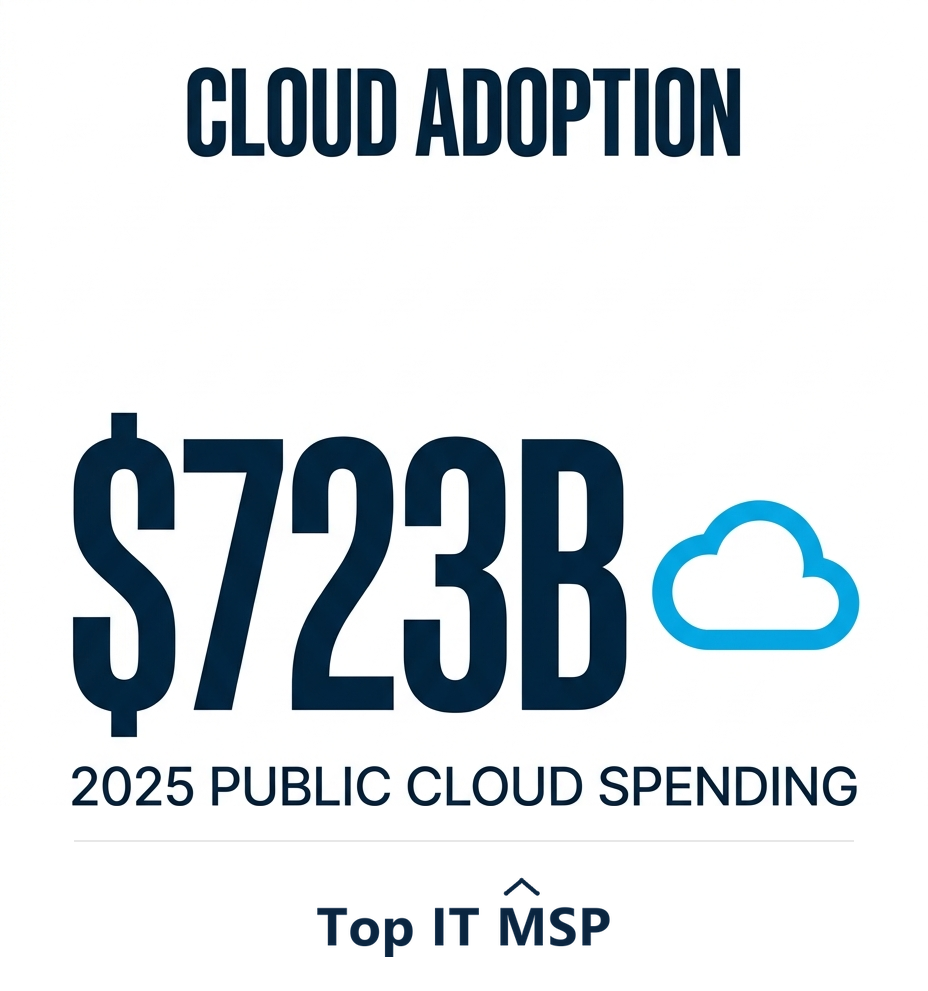
This matters because the cloud is now where business runs, with worldwide public cloud spending forecast to top $723 billion in 2025, up from about $595.7 billion in 2024. Picking the wrong type wastes money or creates risk, while the right mix delivers cost savings, flexibility, and security. This guide explains both dimensions in plain English. It pairs with our cloud services overview and our guide to public vs private cloud.
Deployment models: who owns the cloud
Deployment models describe where the cloud lives and who shares it:
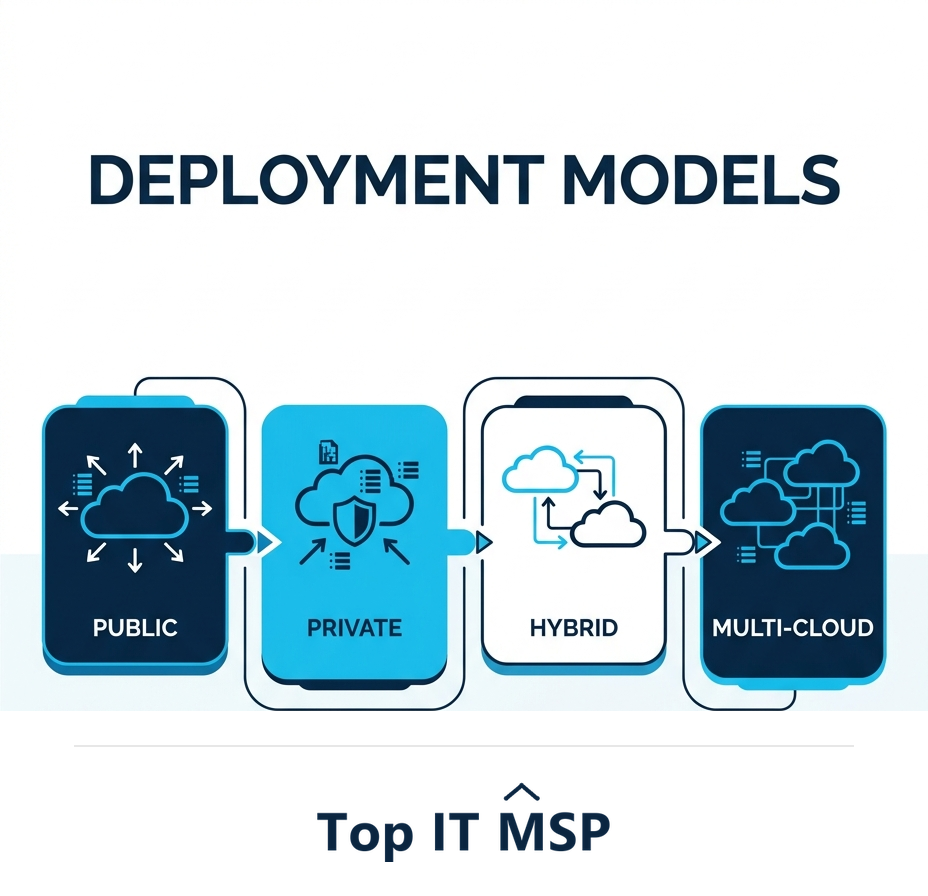
- Public cloud. Shared infrastructure run by a provider such as Microsoft Azure, AWS, or Google Cloud. You draw resources from a massive shared pool on demand. Lowest entry cost, effortless scale, no hardware to manage.
- Private cloud. Infrastructure dedicated to a single organization, hosted in your data center or by a provider just for you. Maximum control and isolation, at higher cost, often chosen for strict compliance.
- Hybrid cloud. A connected mix of public and private, so workloads and data can move between them. Keep sensitive systems private and run everything else in the public cloud.
- Multi-cloud. Using more than one public cloud provider at once, to avoid lock-in, use the best service from each, or improve resilience. Common in larger organizations.
Service models: who manages what
Service models describe how much of the work the provider handles for you. The three main ones form a ladder, from most control (and most responsibility) to least. The classic analogy is pizza: make it from scratch, take and bake, delivery, or dine out, each hands off more of the work.
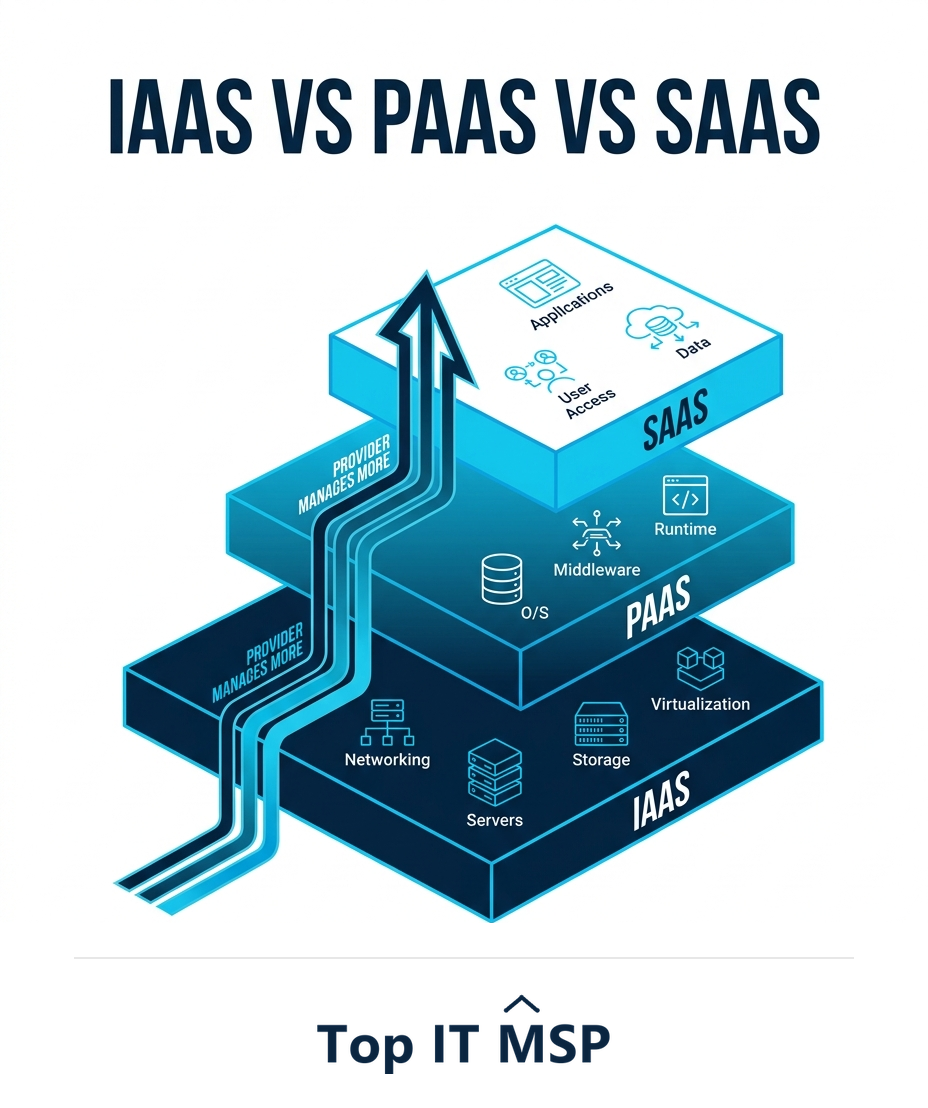
- IaaS (Infrastructure as a Service). The provider supplies raw computing, storage, and networking, and you manage the operating systems, applications, and data on top. Maximum control and flexibility. Examples: Azure virtual machines, AWS EC2.
- PaaS (Platform as a Service). The provider manages the infrastructure and the platform, so your team just builds and runs applications without managing servers. Great for developers. Examples: Azure App Service, Google App Engine.
- SaaS (Software as a Service). The provider manages everything, and you simply use the software through a browser. The most common type by far. Examples: Microsoft 365, Salesforce, Google Workspace.
A simple rule: the further up the ladder from IaaS to SaaS, the less you manage and the faster you move, but the less control you have over the underlying technology. Most businesses sit mostly in SaaS and reach for PaaS or IaaS only when they need to build something custom.
How the types fit together
The two dimensions combine. You might run a SaaS email platform (public cloud, SaaS), host a custom application on IaaS in the public cloud, and keep a sensitive database on a private cloud, all at once. That is normal. Most businesses are not on a single type of cloud; they use a blend, choosing the model that fits each workload's needs for cost, control, and compliance. The skill is matching workload to type rather than forcing everything into one box, since no single model is best at cost, control, and convenience all at once.
A concrete example makes this real. Imagine a growing retailer. It runs Microsoft 365 for email and documents, which is SaaS on the public cloud, with nothing to manage. It chooses to deploy its custom online store on PaaS, so developers ship features without touching servers. Its data analytics run on scalable IaaS that expands automatically during holiday traffic and shrinks afterward. And because payment data is sensitive, it keeps that database in a private cloud for tighter control. One business, four different cloud types, each chosen because it fits the job. When you deploy each workload to the model that suits it, you get a setup that is both cost-effective and scalable rather than a compromise stretched across everything.
Which type should you use?
There is no single best type, only the best fit per workload. For everyday business software like email, documents, and CRM, SaaS in the public cloud is almost always the answer, because there is nothing to build or maintain and you are productive immediately. For custom applications, IaaS or PaaS in the public cloud offers flexibility and scale, with PaaS removing server management and IaaS keeping the most control. For highly sensitive or strictly regulated data, a private cloud may be warranted, often within a hybrid setup. Larger organizations may add multi-cloud to avoid lock-in. Whatever the mix, security follows you across every type under the shared responsibility model, and with the average data breach costing $4.88 million, taking about 258 days to identify and contain, and reported cybercrime losses topping $12.5 billion a year, configuration and governance matter regardless of which types you choose.
Getting the mix right
Choosing and combining cloud types well is a strategic skill, and getting it wrong is expensive, in cost, performance, or security. Specialist cloud expertise is scarce amid a global shortfall of about 4.8 million cybersecurity and IT professionals, which is part of why so many businesses lean on partners. The managed services market is projected to grow from about $330 billion in 2024 to about $879 billion over the next decade, as organizations hand cloud strategy and management to specialists who can match each workload to the right model and run it securely.
If you want help designing the right cloud mix, an experienced partner pays for itself. To start from a vetted, merit-ranked list, browse providers by city in the Top IT MSP directory, where ranking is earned on rating and verified data.
Frequently asked questions
What are the types of cloud computing?
Cloud computing types fall into two dimensions. Deployment models, public, private, hybrid, and multi-cloud, describe who owns and shares the infrastructure. Service models, IaaS, PaaS, and SaaS, describe how much the provider manages versus you. Every cloud setup combines one deployment model with one or more service models.
What is the difference between IaaS, PaaS, and SaaS?
They differ by how much the provider manages. With IaaS the provider supplies raw infrastructure and you manage the operating systems, apps, and data, giving maximum control. With PaaS the provider also manages the platform so you just build and run applications. With SaaS the provider manages everything and you simply use the software, as with Microsoft 365.
What are the cloud deployment models?
The deployment models are public cloud (shared infrastructure run by a provider), private cloud (dedicated to one organization), hybrid cloud (a connected mix of public and private), and multi-cloud (using more than one public provider at once). They describe where the cloud lives and who shares the underlying infrastructure.
What is the most common type of cloud computing?
SaaS (Software as a Service) running on public cloud is the most common type by far, because almost every business uses cloud software such as email, documents, and CRM through a browser. Most organizations also use other types alongside it, blending models to fit different workloads.
Should a business use just one type of cloud?
Rarely. Most businesses use a blend, for example SaaS for everyday software, IaaS or PaaS for custom applications, and sometimes a private cloud for sensitive data within a hybrid setup. The goal is to match each workload to the model that best fits its needs for cost, control, and compliance, not to force everything into one type.
How do I choose the right cloud type?
Choose per workload. SaaS in the public cloud suits everyday business software, IaaS or PaaS suits custom applications needing flexibility, and private or hybrid cloud suits highly sensitive or regulated data. Larger organizations may add multi-cloud to avoid lock-in. A provider can assess your workloads and recommend the right model for each.
Related reading
Design the right cloud mix for your business
Top IT MSP is the independent directory of vetted managed IT providers across North America. Compare merit-ranked firms in your city that design and run public, private, hybrid, and multi-cloud. No pay-to-play.
Top IT MSP is an independent directory that connects you with vetted managed IT providers. Browse the directory city by city:
- Managed IT Services in Los Angeles
- Managed IT Services in Chicago
- Managed IT Services in Houston
- Managed IT Services in Dallas
- Managed IT Services in Portsmouth, NH
- Managed IT Services in Providence
- Managed IT Services in Raleigh
- Managed IT Services in Reno
- Managed IT Services in Richmond
- Managed IT Services in Rochester, MN