IAM Best Practices for Business
Identity and access management (IAM) controls who can access what in your business, and it has become the front line of security because identity is the new perimeter. The core best practices: enforce least privilege, require multi-factor authentication everywhere, use role-based access, manage the full identity lifecycle (joiners, movers, leavers), protect privileged accounts, monitor access, and move toward a Zero Trust model.
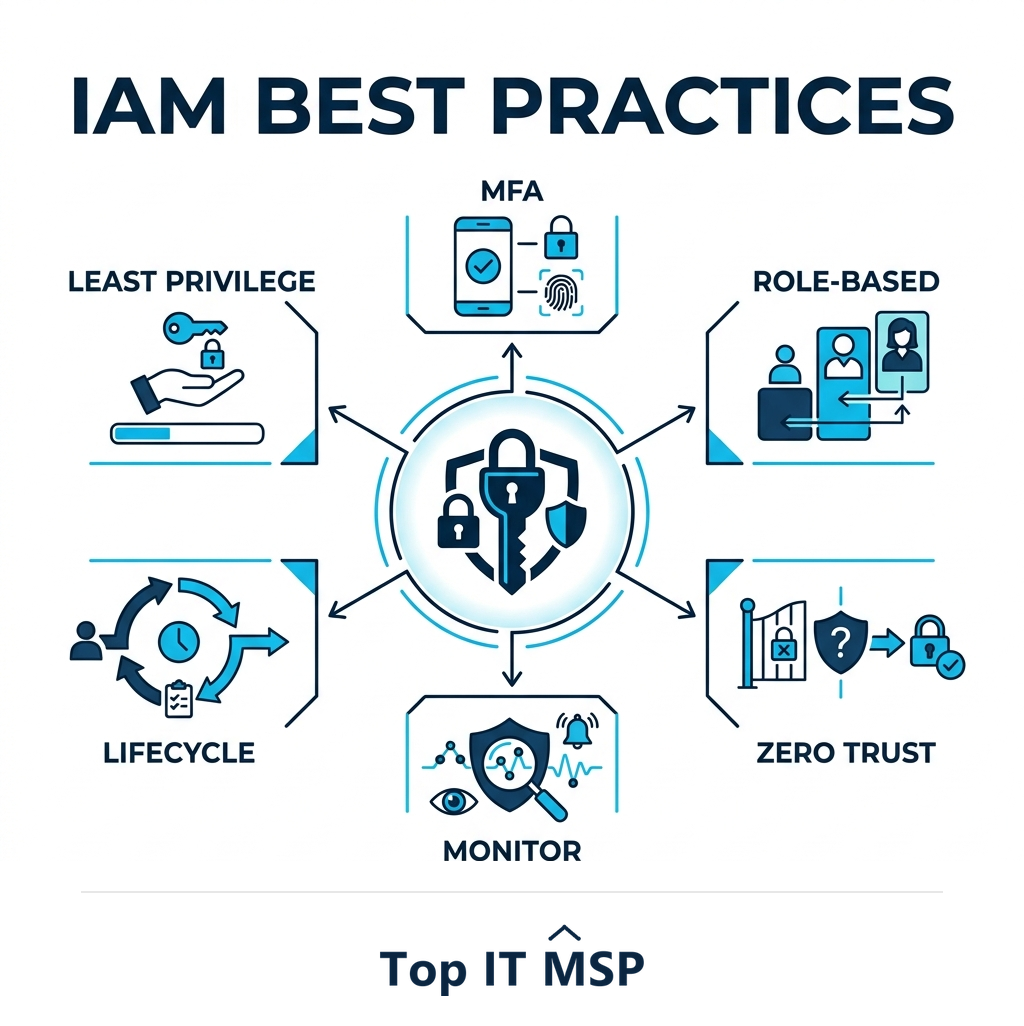
- IAM controls who can access what; identity is now the main security perimeter.
- Enforce least privilege: give every account only the access it actually needs.
- Require multi-factor authentication everywhere, especially for admin and remote access.
- Manage the full identity lifecycle, and revoke access immediately when people leave.
- Protect privileged accounts and monitor access, working toward a Zero Trust model.
Why IAM is the front line of security
Identity and access management (IAM) is how a business controls who can access what: managing user identities and the permissions that govern which systems, applications, and data each person can reach. It has quietly become the front line of cybersecurity, because as work has moved to the cloud and beyond the office, identity, not the network firewall, is the real perimeter. If an attacker steals or guesses the right credentials, they can walk in the front door no matter how good your other defenses are. That is exactly how most breaches happen: the human element is involved in 68 percent of breaches, and compromised credentials are a leading entry point.
Getting IAM right both prevents breaches and limits the damage when one occurs, which matters when the average data breach costs $4.88 million and reported cybercrime losses topped $12.5 billion in a single year. This guide covers the IAM best practices every business should follow. It pairs with our cybersecurity services overview and complements our guide on MFA vs 2FA.
1. Enforce least privilege
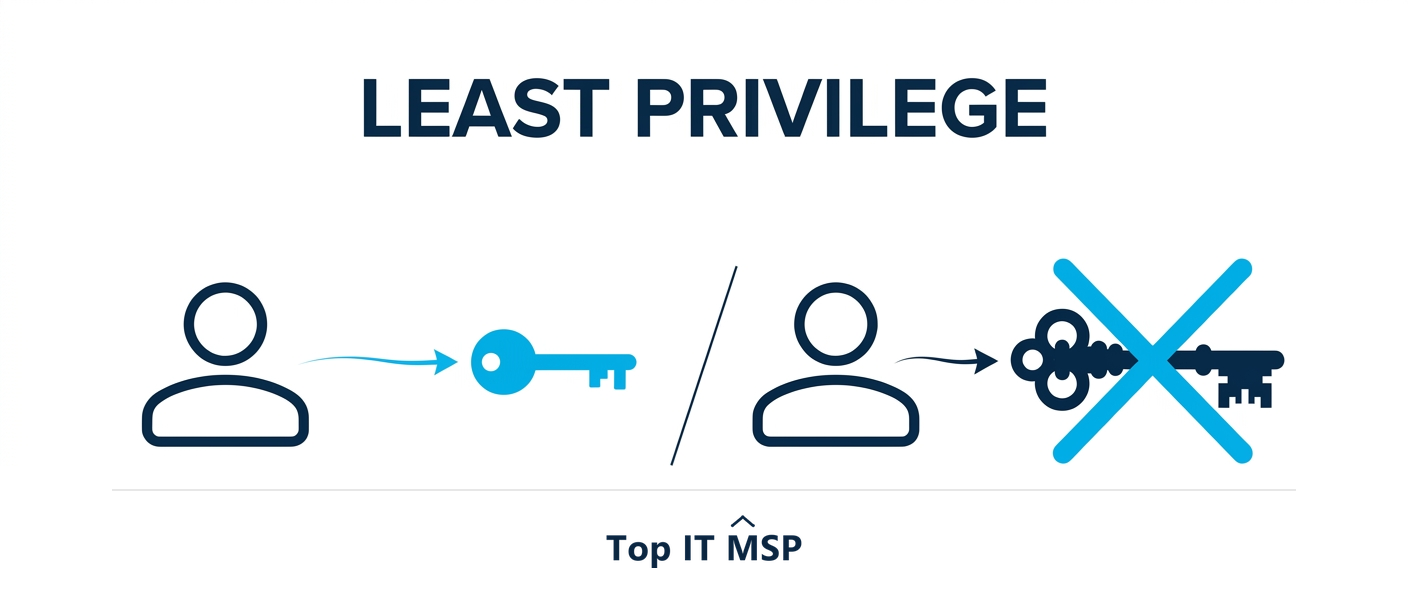
The foundational IAM principle is least privilege: give every user and account only the access it genuinely needs to do its job, and no more. Over-privileged accounts are dangerous because if one is compromised, the attacker inherits all that excess access, so a single breach reaches far more than it should. Least privilege contains the blast radius of any compromise. In practice, that means starting accounts with minimal access and granting more only when justified, rather than the common but risky habit of giving broad access by default for convenience. It applies to people and to machine and service accounts alike.
2. Require multi-factor authentication everywhere
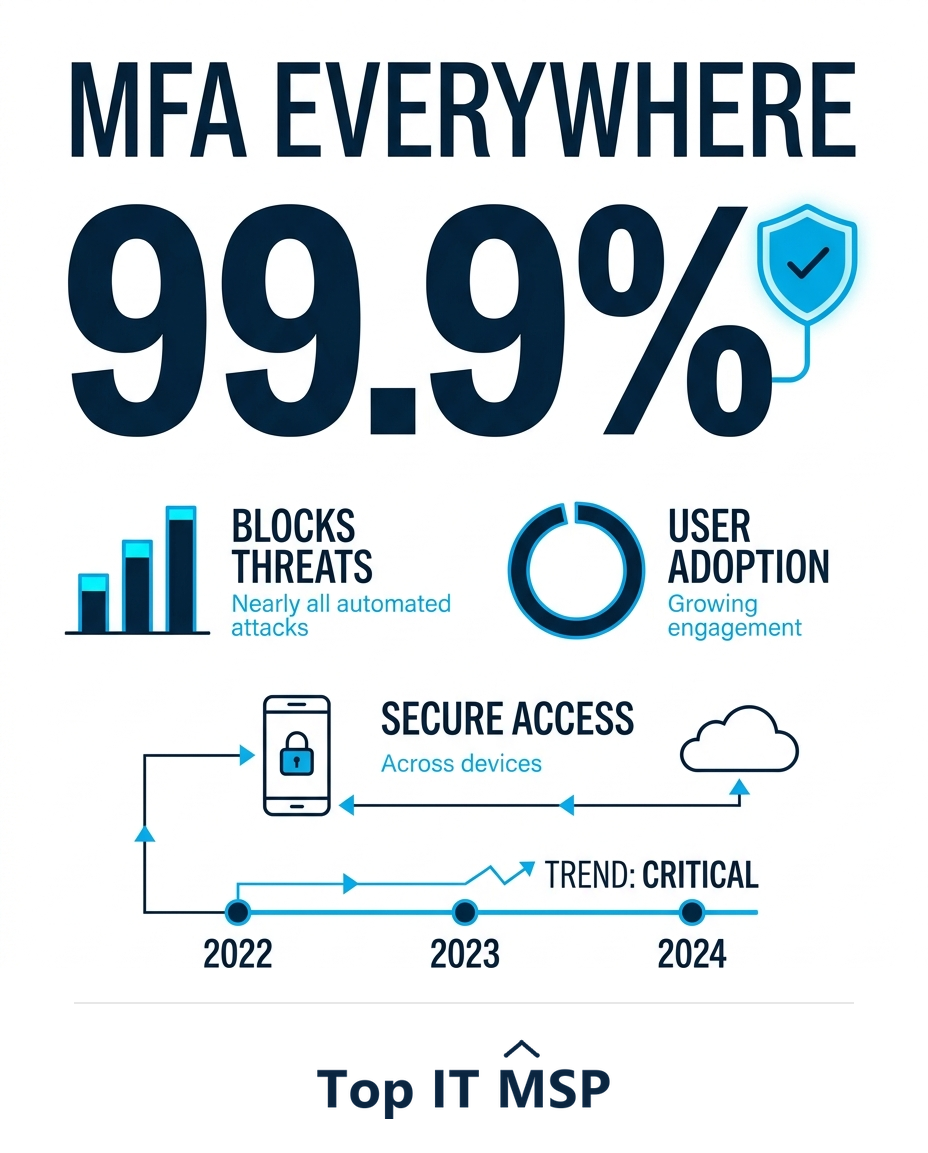
Passwords alone are not enough, because they are routinely stolen, guessed, and phished. Multi-factor authentication (MFA) requires a second proof of identity, so a stolen password is not enough to get in, and it is the single most effective IAM control: Microsoft has reported that MFA blocks 99.9 percent of automated account-compromise attacks. Require it everywhere, with no exceptions, and especially for email, remote access, and administrative accounts, the highest-value targets. Prefer phishing-resistant factors like authenticator apps or hardware keys over text-message codes where you can. MFA is the difference between a stolen password being a minor event and being a breach.
3. Use role-based access control
Managing permissions one user at a time does not scale and leads to inconsistency and mistakes. Role-based access control (RBAC) groups permissions into roles that map to job functions, then assigns people to roles. A new salesperson gets the sales role with exactly the access that role needs; when they change jobs, you change their role. RBAC makes access consistent, easier to manage, and far easier to audit, because you can see at a glance what each role can do rather than untangling thousands of individual permissions. It is the practical mechanism that makes least privilege manageable across a growing organization.
4. Manage the full identity lifecycle
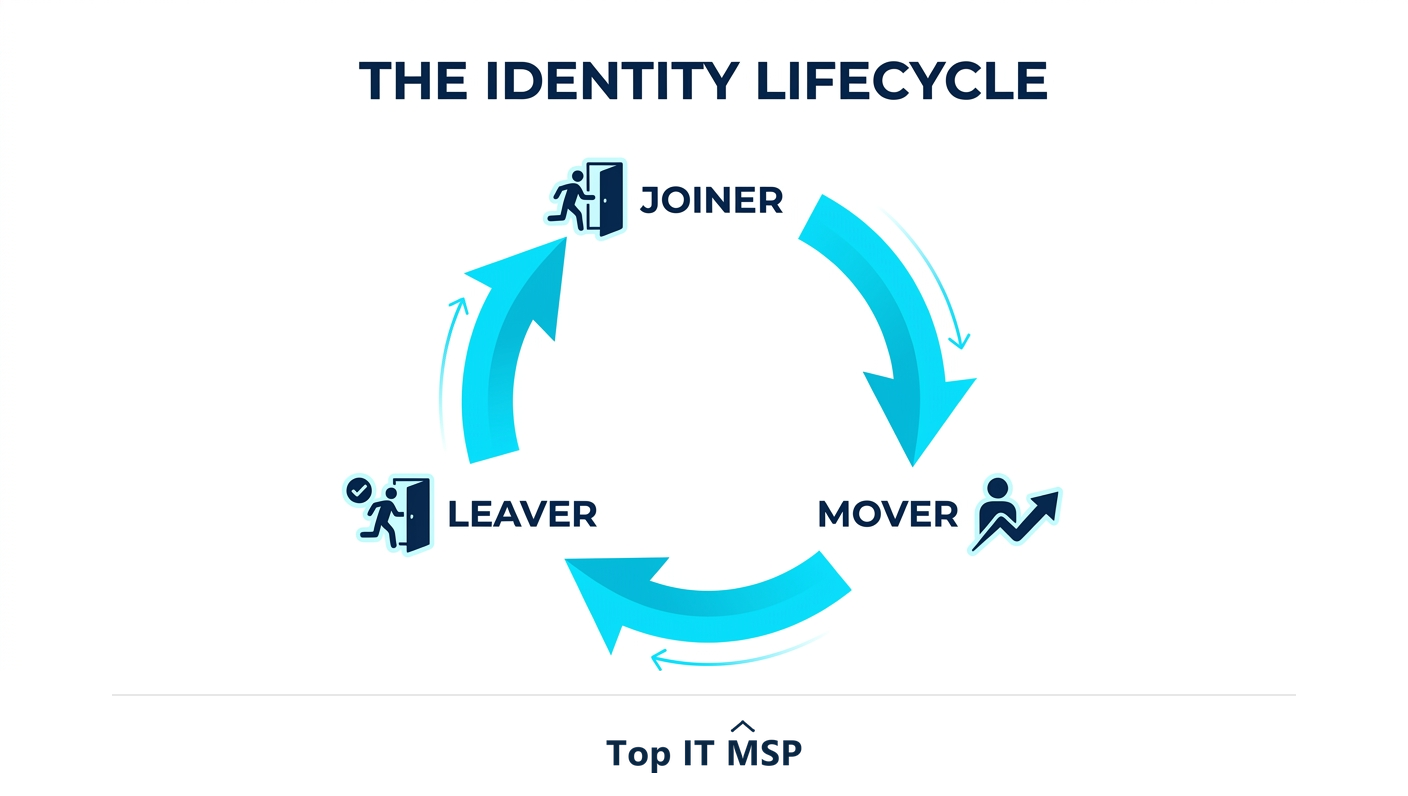
Every identity has a lifecycle, often called joiners, movers, and leavers, and managing it well is critical. When someone joins, provision their access promptly and appropriately. When they move roles, adjust their access to match the new role and remove what they no longer need (otherwise people accumulate excessive access over years, a problem called privilege creep). When they leave, revoke all access immediately, because lingering accounts of former employees are a serious and common security gap. Automating this lifecycle, so access is granted and especially revoked reliably and instantly, closes one of the most exploited holes in IAM.
5. Protect privileged accounts
Not all accounts are equal. Privileged accounts, administrators, IT staff, and anyone with elevated access, are the crown jewels, because compromising one gives an attacker enormous power. Give them extra protection: require strong MFA, limit how many privileged accounts exist, avoid using admin accounts for everyday work, and consider privileged access management (PAM) tools that grant elevated access only just-in-time and record what is done with it. Watching and tightly controlling privileged access dramatically reduces the impact of a breach, because these are exactly the accounts attackers hunt for once inside.
6. Monitor, log, and audit access
IAM is not set-and-forget. Continuously monitor and log access: who logged in, from where, and what they accessed, so you can detect anomalies like a login from an unusual location, a sudden privilege change, or access at odd hours that may signal a compromised account. Regularly audit access rights to catch privilege creep, unused accounts, and excessive permissions, and remove them. This monitoring matters because attackers who steal credentials often lurk undetected for a long time, contributing to breaches that take about 258 days to identify and contain on average. Good logging is what shortens that window.
7. Move toward Zero Trust
The modern direction for IAM is Zero Trust, built on the principle never trust, always verify. Rather than trusting anyone once they are inside the network, Zero Trust treats every access request as potentially hostile and verifies identity, device health, and context every time, granting only the minimum access needed for that request. IAM is the heart of Zero Trust, because strong identity verification, least privilege, and continuous monitoring are exactly what it depends on. You do not adopt Zero Trust overnight, but every IAM best practice above is a step toward it, and it is increasingly the model security teams and insurers expect.
Getting IAM right
Strong IAM ties together least privilege, MFA, role-based access, lifecycle management, privileged-access protection, monitoring, and Zero Trust into one coherent program. Building and running that takes the right tools and expertise, which is scarce amid a global shortfall of about 4.8 million cybersecurity professionals, and it is easy to let access sprawl as a business grows. Many businesses implement and manage IAM with a managed IT or security provider that deploys identity tools, enforces MFA and least privilege, automates the joiner-mover-leaver lifecycle, and monitors access, part of why the managed services market is projected to grow from about $330 billion in 2024 to about $879 billion over the next decade. Because identity is the front line, getting IAM right is one of the highest-impact security investments a business can make.
If you want to lock down who can access what across your business, a provider can put these IAM practices in place and manage them. To find one, browse vetted, merit-ranked firms by city in the Top IT MSP directory, where ranking is earned on rating and verified data.
Frequently asked questions
What is identity and access management (IAM)?
IAM is how a business controls who can access what: managing user identities and the permissions that govern which systems, applications, and data each person can reach. It has become the front line of cybersecurity because, as work moved to the cloud, identity rather than the network firewall is now the real perimeter, and stolen credentials are a leading way breaches happen.
What are IAM best practices?
The core best practices are: enforce least privilege, require multi-factor authentication everywhere, use role-based access control, manage the full identity lifecycle of joiners, movers, and leavers, protect privileged accounts, continuously monitor and audit access, and work toward a Zero Trust model. Together they prevent breaches and limit the damage when one occurs.
What is least privilege in IAM?
Least privilege means giving every user and account only the access it genuinely needs to do its job, and no more. It matters because over-privileged accounts are dangerous: if one is compromised, the attacker inherits all that excess access. Least privilege contains the blast radius of any compromise and applies to people and to machine and service accounts alike.
Why is managing the identity lifecycle important?
Because access must be granted, adjusted, and revoked as people join, change roles, and leave. Without lifecycle management, people accumulate excessive access over time (privilege creep), and former employees' accounts often linger, a serious and common security gap. Automating the joiner-mover-leaver process, especially immediate revocation when someone leaves, closes one of the most exploited IAM holes.
How does IAM relate to Zero Trust?
IAM is the heart of Zero Trust, the model built on never trust, always verify. Zero Trust treats every access request as potentially hostile and verifies identity, device, and context every time, granting only the minimum access needed. Strong identity verification, least privilege, and continuous monitoring, all IAM best practices, are exactly what Zero Trust depends on.
How do I improve IAM in my business?
Start with the highest-impact controls: enforce MFA everywhere and apply least privilege, then add role-based access, automate the joiner-mover-leaver lifecycle, protect privileged accounts, and monitor access. Because building and running a coherent IAM program takes tools and scarce expertise, many businesses implement and manage it with a managed IT or security provider.
Related reading
Lock down who can access what
Top IT MSP is the independent directory of vetted managed IT and security providers across North America. Compare merit-ranked firms in your city that deploy and manage IAM, MFA, and Zero Trust. No pay-to-play.
Top IT MSP is an independent directory that connects you with vetted managed IT providers. Browse the directory city by city:
- Managed IT Services in New York
- Managed IT Services in Los Angeles
- Managed IT Services in Chicago
- Managed IT Services in Houston
- Managed IT Services in Tucson
- Managed IT Services in Tulsa
- Managed IT Services in Vancouver
- Managed IT Services in Virginia Beach
- Managed IT Services in Washington, D.C.
- Managed IT Services in Wichita