Manufacturing IT Support Explained
IT services for manufacturing are specialized because manufacturers run both traditional IT and operational technology (OT), the industrial control systems that run production, where downtime halts the line and a cyberattack can stop the business. Manufacturing is the most-attacked industry for cyberattacks, often runs unpatched legacy equipment, and depends on connected supply chains. Good manufacturing IT support secures the IT/OT environment, maximizes uptime, protects against ransomware, and bridges the gap between the front office and the factory floor.
- Manufacturers run both IT and operational technology (OT), the systems that control production.
- Downtime on the factory floor is exceptionally costly, so uptime and reliability are paramount.
- Manufacturing is the most-attacked industry for cyberattacks, often via legacy and OT systems.
- Legacy machinery and OT are hard to patch, widening the attack surface.
- Good manufacturing IT support secures the converged IT/OT environment and protects production.
Why manufacturing IT is specialized
Manufacturers run two worlds of technology at once. There is traditional IT, the email, ERP, design, and office systems that any business has, and there is operational technology (OT): the industrial control systems, PLCs, and connected machinery that actually run the production line. These worlds were once separate, but they have steadily converged, and that convergence is exactly where manufacturing's distinctive IT challenges live. A problem in IT can halt the office; a problem in OT can halt production entirely. Add the facts that manufacturing is the single most-attacked industry for cyberattacks, that much of its equipment is legacy and hard to patch, and that it depends on connected supply chains, and it is clear that IT services for manufacturing are a specialized discipline. This guide explains what makes manufacturing IT different and what good support looks like.
It pairs with our IT services for manufacturing overview and the cybersecurity services page, and connects to our guide on cloud security threats.
The challenges unique to manufacturing
Several pressures shape what a manufacturer needs from its technology:
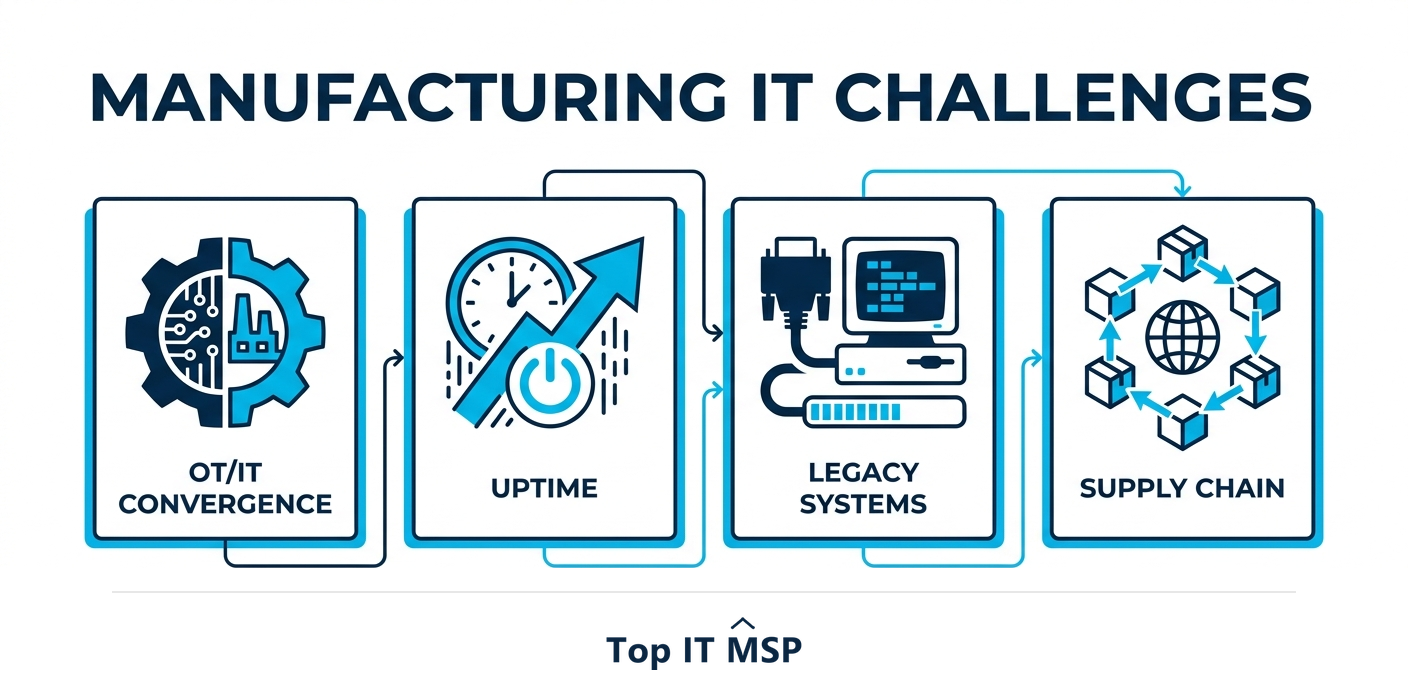
- OT and IT convergence. Connecting industrial control systems to the network unlocks efficiency but exposes once-isolated machinery to cyber threats.
- Production uptime. A stopped line is enormously costly, so reliability is mission-critical, with downtime costing most organizations more than $100,000 an hour and often far more on a production floor.
- Legacy equipment. Machinery can run for decades on old, unpatchable software, creating security gaps that cannot simply be updated away.
- Supply-chain connectivity. Manufacturers are tightly integrated with suppliers and customers, so a compromise can ripple outward, and attackers target that.
- Safety and physical impact. Unlike pure IT, an OT incident can affect physical equipment and worker safety, raising the stakes.
What manufacturing IT support includes
Effective manufacturing IT support spans both the front office and the factory floor:
- IT/OT security. Protecting both traditional IT and operational technology, with network segmentation that isolates OT so a breach cannot jump from email to the production line.
- Network and infrastructure management. Reliable, well-designed networks connecting office systems, machines, and sites.
- Uptime-focused monitoring. Proactive monitoring to catch and resolve issues before they stop production.
- Backup and disaster recovery. Tested backups and recovery plans so an incident does not mean prolonged downtime or lost data.
- ERP and application support. Keeping the core business systems manufacturers run on available and integrated.
- Legacy system protection. Compensating controls and segmentation to secure equipment that cannot be patched.
OT/IT convergence and security
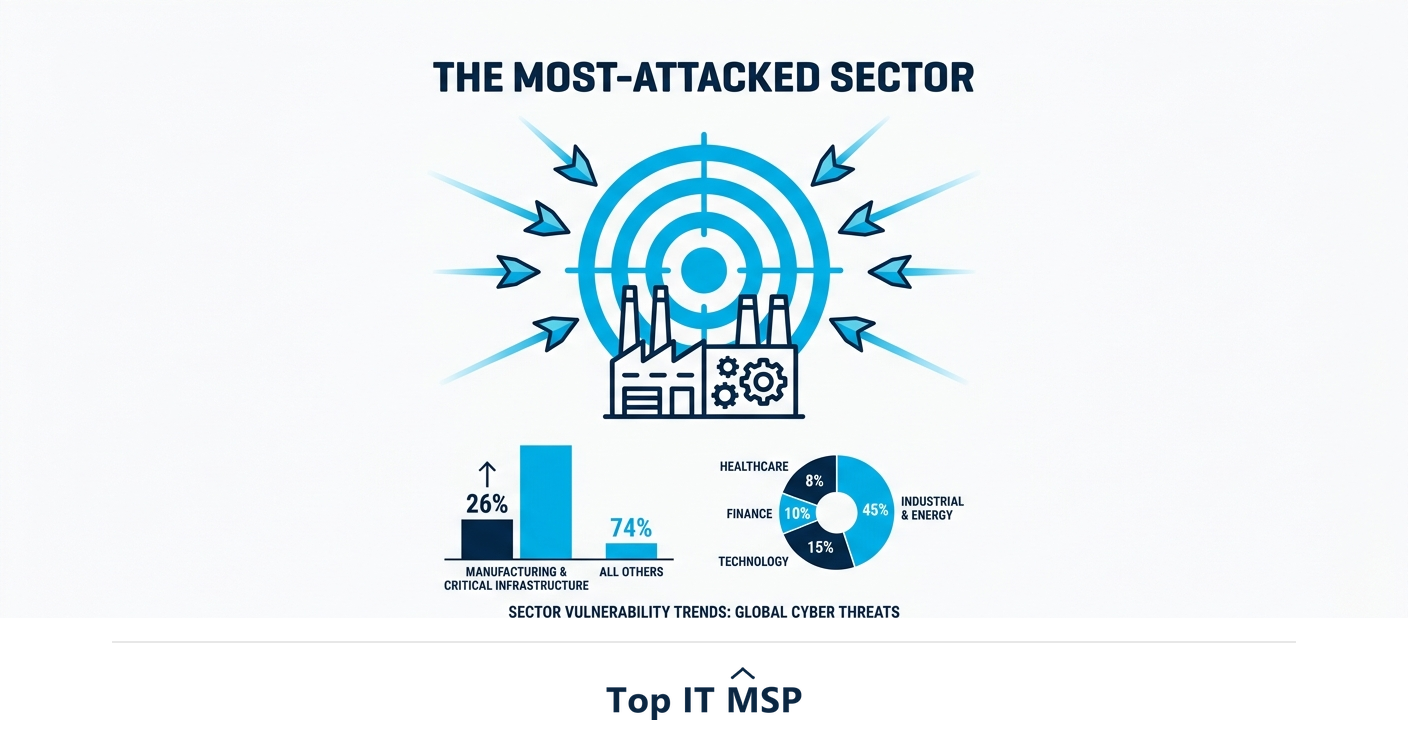
The defining security challenge in manufacturing is the convergence of OT and IT. For efficiency, manufacturers connect industrial control systems, sensors, and machines to their networks, but much of that equipment was designed for isolated environments, with little built-in security and no way to patch it. The result is a large, exposed attack surface, and attackers have noticed: manufacturing has been the most-attacked industry for cyberattacks for several years running, according to IBM's X-Force threat research. Ransomware is a particular danger because the threat of a stopped line pressures manufacturers to pay. The core defense is segmentation, keeping OT networks separated from IT and the internet so a phishing email, the human element is involved in 68% of breaches, cannot reach the factory floor, along with monitoring tuned for OT and the average breach cost of $4.88 million as a reminder of the stakes. Automation helps, saving breached organizations an average of $2.22 million.
Uptime and the cost of a stopped line
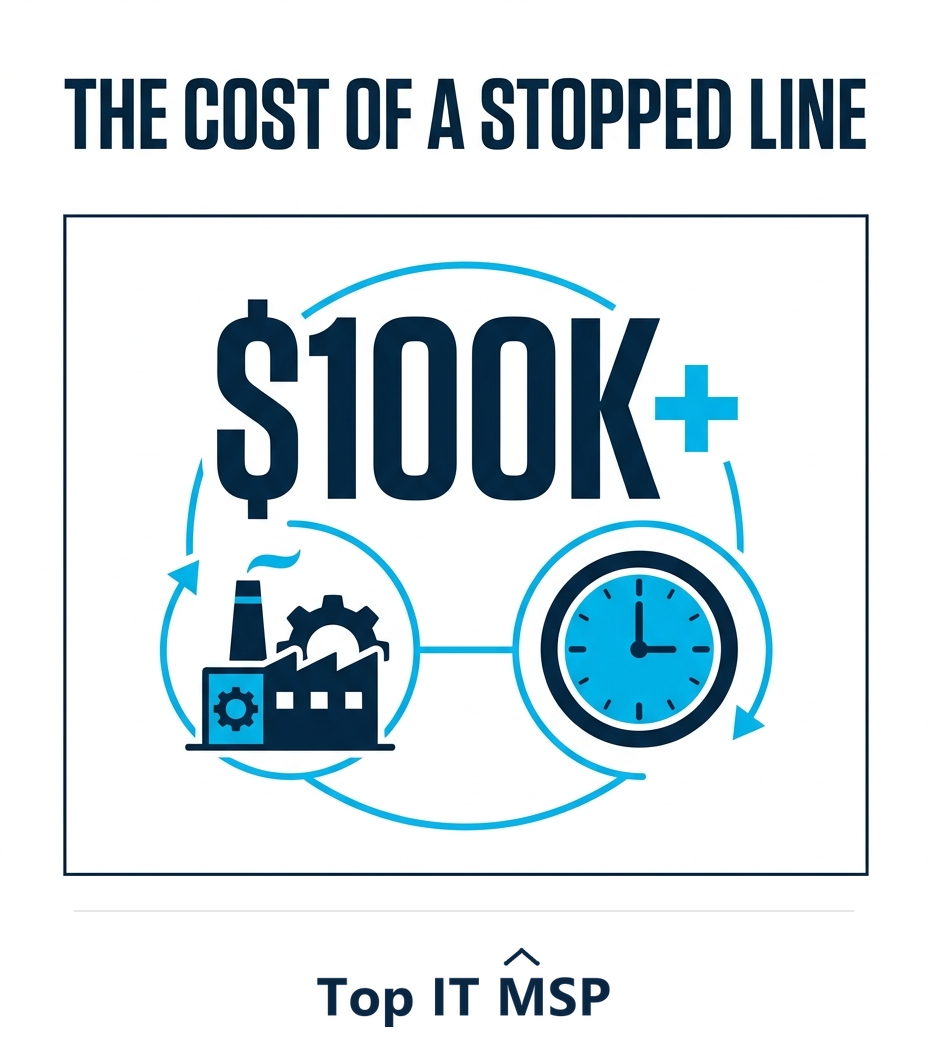
In manufacturing, downtime is not an inconvenience, it is lost product, missed shipments, idle workers, and broken commitments to customers. While downtime costs most organizations more than $100,000 an hour, on a high-volume production line the figure can be far higher, which is why uptime drives so many manufacturing IT decisions. This makes proactive monitoring, redundancy, and fast response essential, the goal is to catch a failing component or a developing issue before it stops the line, not to react after production has halted. It also makes reliable backup and recovery vital, because a ransomware attack or system failure that takes down production must be recoverable in hours, not days. Slow detection works against this, with breaches taking an average of 258 days to identify and contain, so manufacturing IT support has to combine prevention with the ability to respond fast when something does go wrong.
Why specialized manufacturing IT matters
A generalist IT provider can manage office systems, but manufacturing's IT/OT environment rewards specific experience. A provider that understands manufacturing knows how to secure and segment operational technology without disrupting production, plans for the extreme cost of downtime on a line, understands the ERP and industrial systems manufacturers depend on, and can protect legacy equipment that cannot be patched. That specialized knowledge is hard to build in-house, especially given a global shortfall of about 4.8 million cybersecurity professionals, which is why many manufacturers turn to experienced providers, part of a managed services market growing from about $330 billion in 2024 toward $879 billion over the next decade. The right partner bridges the gap between the front office and the factory floor, keeping both secure and running.
Getting manufacturing IT right
For a manufacturer, technology now spans the office and the production line, and securing and supporting both is essential to staying competitive and resilient. The right IT services protect the converged IT/OT environment with segmentation and monitoring, maximize uptime through proactive support and redundancy, defend against the ransomware that makes manufacturing a top target, and keep legacy and modern systems alike running reliably. Because manufacturing is the most-attacked sector and a stopped line is so costly, this is an area where specialized, experienced IT support is a genuine competitive advantage, not just an expense.
If you are evaluating IT services for your manufacturing business, comparing vetted providers on merit is the place to start. Browse merit-ranked managed IT firms by city in the Top IT MSP directory, where ranking is earned on rating and verified data, not on who pays the most. You can also explore the full managed IT services hub.
Frequently asked questions
Why do manufacturers need specialized IT support?
Because manufacturers run both traditional IT and operational technology (OT), the industrial control systems that run production, where downtime halts the line. Manufacturing is also the most-attacked industry for cyberattacks, often runs unpatchable legacy equipment, and depends on connected supply chains. Securing and supporting this converged IT/OT environment requires specialized experience that generalist IT often lacks.
What is OT/IT convergence in manufacturing?
OT/IT convergence is the connecting of operational technology, the industrial control systems, sensors, and machines that run production, with traditional IT networks. It unlocks efficiency and data but exposes once-isolated machinery, much of it designed without security and unable to be patched, to cyber threats. Managing it safely, especially through network segmentation, is the defining security challenge in manufacturing IT.
Why is manufacturing the most-attacked industry?
Because manufacturers present a large, often poorly defended attack surface, much of their OT and legacy equipment cannot be patched, and the threat of halting production gives attackers powerful ransomware leverage, manufacturers are pressured to pay quickly to restart the line. IBM's X-Force research has identified manufacturing as the most-attacked industry for several years running.
What does manufacturing IT support include?
It includes IT/OT security with network segmentation that isolates operational technology, reliable network and infrastructure management, uptime-focused proactive monitoring, tested backup and disaster recovery, ERP and application support, and protection for legacy systems that cannot be patched. It spans both the front office and the factory floor, with a strong emphasis on security and uptime.
How costly is downtime for a manufacturer?
Very. While downtime costs most organizations more than $100,000 an hour, on a high-volume production line the figure can be far higher, accounting for lost product, missed shipments, idle workers, and broken customer commitments. This is why uptime drives so many manufacturing IT decisions and why proactive monitoring, redundancy, and fast recovery are essential.
How do you secure legacy equipment in manufacturing?
Since legacy machinery often runs old software that cannot be patched, the approach is compensating controls rather than updates: segmenting that equipment onto isolated networks so it cannot be reached from IT or the internet, monitoring it for unusual activity, and tightly controlling access. This contains the risk that unpatchable systems create without forcing a costly equipment replacement.
Related reading
Keep your office and your line running
Top IT MSP is the independent directory of vetted managed IT providers across North America. Compare merit-ranked firms in your city with manufacturing and OT experience. No pay-to-play.
Top IT MSP is an independent directory that connects you with vetted managed IT providers. Browse the directory city by city:
- Managed IT Services in Chicago
- Managed IT Services in Houston
- Managed IT Services in Dallas
- Managed IT Services in Phoenix
- Managed IT Services in Plano
- Managed IT Services in Portland
- Managed IT Services in Portland, ME
- Managed IT Services in Portsmouth, NH
- Managed IT Services in Providence
- Managed IT Services in Raleigh