What Is Cyber Vandalism?
Cyber vandalism is a destructive cyberattack aimed at damage or disruption rather than profit. Cyber vandals deface websites, corrupt or delete data, hijack accounts, and disrupt services, often for notoriety, protest, or simple malice. Even without theft, it causes real costs: downtime, reputational harm, and recovery expense. The defenses are the same cybersecurity fundamentals that stop other attacks: strong access control, monitoring, backups, and patching.
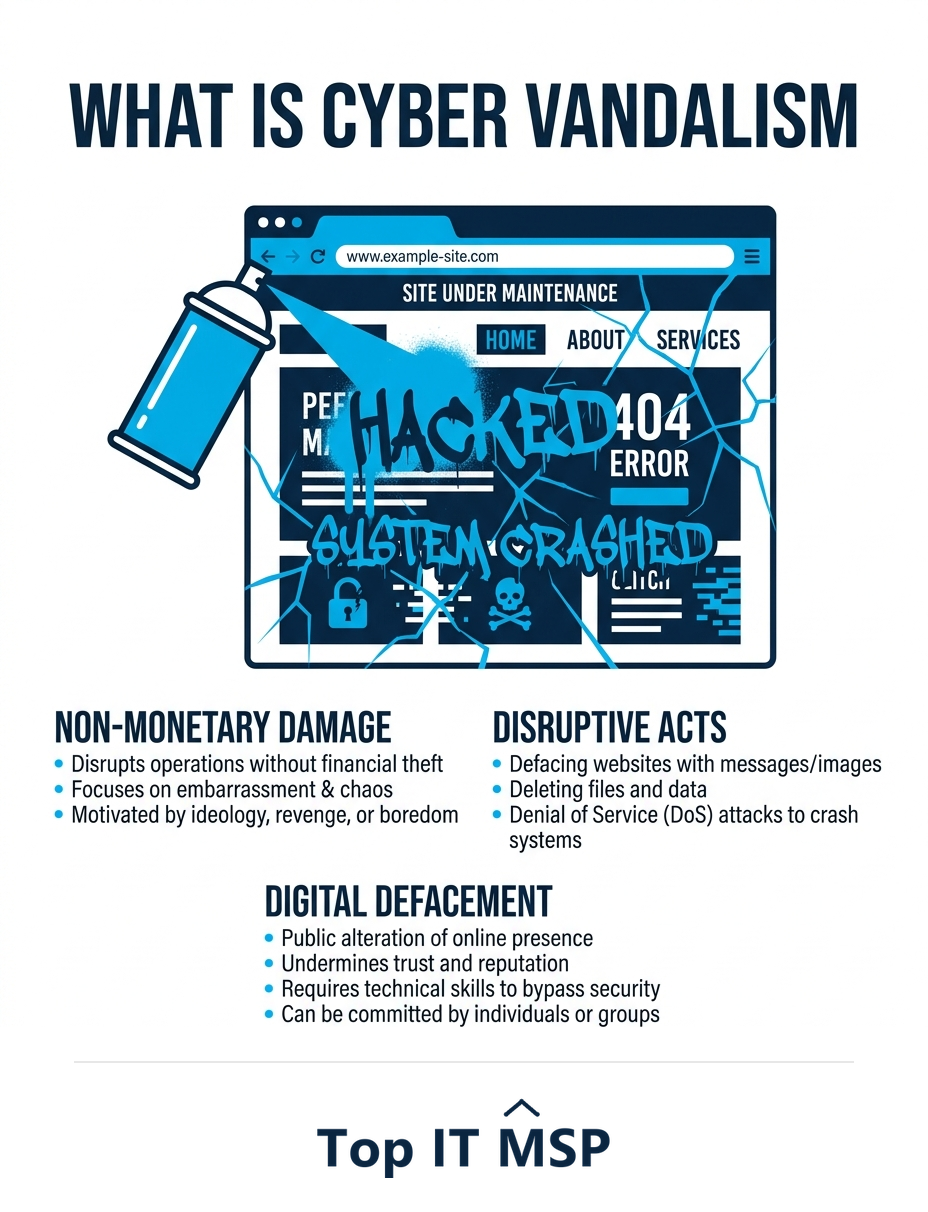
- Cyber vandalism is destruction or disruption for its own sake, not for financial gain.
- Common forms include website defacement, data corruption, account hijacking, and service disruption.
- It differs from most cybercrime by motive: notoriety, protest, or malice rather than profit.
- The damage is still real: downtime, reputational harm, lost data, and recovery costs.
- It is prevented by the same fundamentals as other attacks: access control, monitoring, backups, and patching.
What is cyber vandalism?
Cyber vandalism is a destructive cyberattack carried out to damage, deface, or disrupt digital property, rather than to steal money or data for profit. Think of it as the digital equivalent of graffiti or smashing a window: the goal is to cause harm, leave a mark, or make a statement. Cyber vandals might rewrite a company's website with offensive messages, wipe or corrupt files, hijack a social media account, or knock a service offline, all without the financial motive that drives most cybercrime. The damage is real even though nothing is stolen, which is exactly why many businesses underestimate it.
It is easy to dismiss vandalism as harmless mischief, but the costs land hard: an hour of downtime costs most organizations more than $100,000, and a defaced or hijacked public presence can damage trust instantly. With reported cybercrime losses topping $12.5 billion in a single year across all categories, destructive attacks are part of a threat landscape no business can ignore, and as more of every business moves online, in a market where public cloud spending is forecast to top $723 billion in 2025, there is simply more digital property to deface or disrupt. This guide explains what cyber vandalism is, its common forms, and how to defend against it. It pairs with our cybersecurity services overview.
Common types of cyber vandalism
Cyber vandalism takes several recognizable forms, all sharing the goal of damage or disruption:
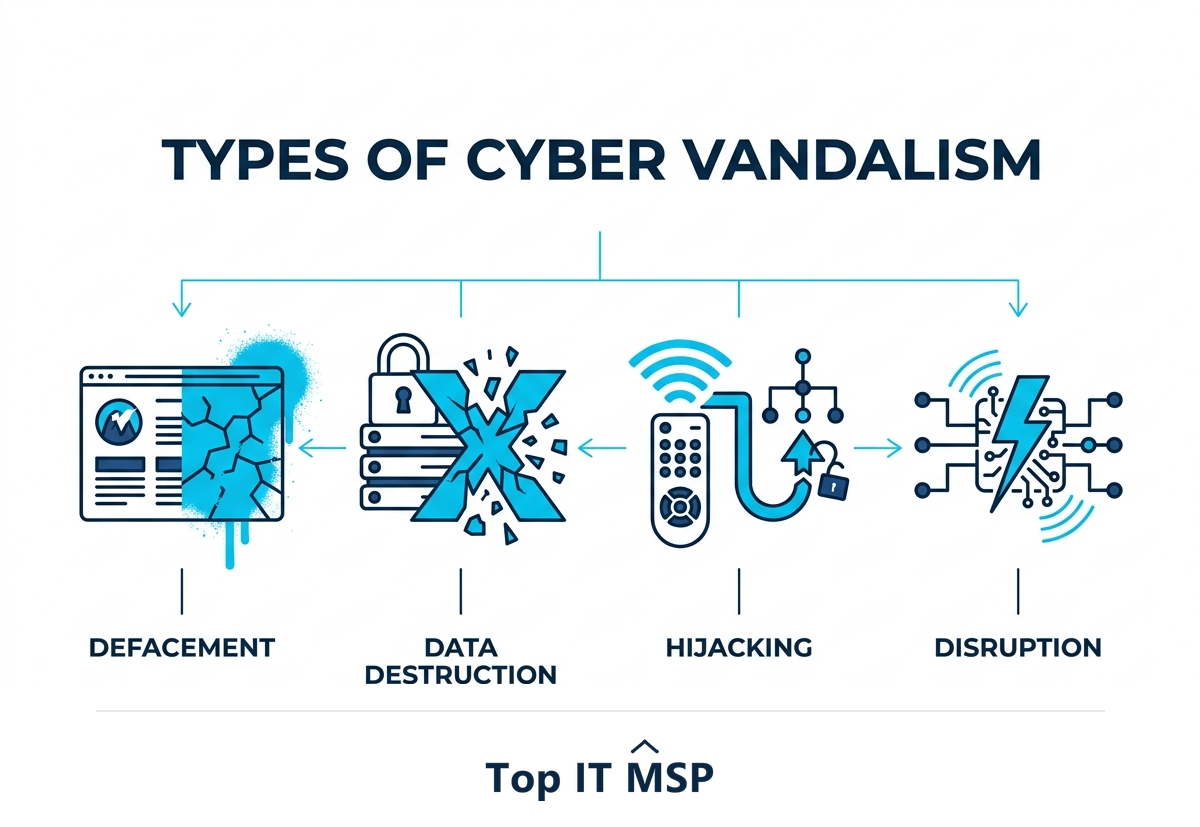
- Website defacement. Attackers replace or alter the content of a website, posting graffiti, offensive material, or political messages where your homepage should be. The most visible form of all, and a direct, very public hit to your reputation.
- Data corruption or deletion. Vandals destroy or scramble files and databases purely to cause damage, not to ransom them. Without good, tested backups, this kind of attack can be devastating.
- Account hijacking and brandjacking. Taking over social media or other accounts to post damaging content, or impersonating a brand to mislead and embarrass it.
- Service disruption. Flooding a website or network to knock it offline, overlapping with denial-of-service attacks when the motive is simply to disrupt.
- Spam and nuisance attacks. Defacing comment sections, forums, or systems with junk content to degrade and disrupt them.
How cyber vandalism differs from other cybercrime
The defining difference is motive. Most cybercrime is financially driven: ransomware demands payment, data theft sells records, fraud chases money. Cyber vandalism is different, the motive is destruction, disruption, notoriety, protest, or simple malice. A cyber vandal may deface a site to show off, to make a political point (sometimes called hacktivism), or just to cause chaos. Because there is no obvious payday, victims sometimes struggle to understand why they were targeted, but the lack of a profit motive does not make the damage any less real. In fact, attackers motivated by malice may be less predictable and less inclined to leave systems recoverable than those after money.
The real business impact
Even without theft, cyber vandalism hurts in several concrete ways. There is downtime, when a defaced or disrupted website or system is offline, directly costing revenue at a rate that exceeds $100,000 an hour for most organizations. There is reputational harm, because customers who see a defaced site or a hijacked account lose confidence fast, and that damage can outlast the technical fix. There is recovery cost, the time and expense of restoring systems, cleaning up, and investigating how it happened. And there is the unsettling signal that your defenses were weak enough to breach at all, which often means other, more profitable attacks are possible too. The most disruptive incidents are not always the most sophisticated: a simple defacement of a customer-facing site can be more disruptive to daily operations than a quiet data theft, because it is public and immediate. And because the average breach takes about 258 days to identify and contain, a disruptive attack that lingers, corrupting backups or spreading across systems, can turn what looks like a one-day cleanup into a multi-week ordeal.

How to protect your business from cyber vandalism
The good news is that the defenses against cyber vandalism are the same cybersecurity fundamentals that stop other attacks, so protecting against it strengthens your whole security posture:

- Strong access control. Use unique passwords, multi-factor authentication, and least-privilege access so attackers cannot easily seize the accounts that control your website and systems.
- Keep software patched. Vandals exploit known vulnerabilities in websites, content management systems, and servers; prompt patching closes those doors.
- Monitor continuously. Detection lets you catch defacement or unusual activity fast and respond before the damage spreads or is widely seen.
- Back up everything and test restores. Reliable, tested backups mean that even if data is corrupted or a site is defaced, you can restore quickly.
- Secure your website and accounts specifically. Harden your CMS, secure your social accounts, and use a web application firewall to filter malicious traffic.
- Train your team. Many attacks start with a phished credential, and the human element features in 68 percent of breaches.
Why the fundamentals matter most
Notice that none of these defenses are exotic. Cyber vandalism is usually opportunistic, exploiting weak passwords, unpatched systems, and unmonitored websites, so the businesses that get hit are typically the ones that skipped the basics. Doing the fundamentals well makes you a far harder target and protects against profit-driven attacks at the same time. The challenge is doing them consistently, which is hard without dedicated expertise amid a global shortfall of about 4.8 million cybersecurity professionals. The average breach still costs $4.88 million, so the investment in basics pays off across every threat, not just vandalism.
Many small and midsize businesses get this protection through a managed provider that handles monitoring, patching, backups, and access control, part of why the managed services market is projected to grow to about $879 billion over the next decade. If you want help hardening your website and systems against vandalism and worse, browse vetted, merit-ranked firms by city in the Top IT MSP directory, where ranking is earned on rating and verified data.
Frequently asked questions
What is cyber vandalism?
Cyber vandalism is a destructive cyberattack carried out to damage, deface, or disrupt digital property rather than to steal money or data. Like digital graffiti, the goal is harm, notoriety, or making a statement. Cyber vandals deface websites, corrupt or delete data, hijack accounts, and disrupt services, causing real damage even though nothing is stolen.
What are common types of cyber vandalism?
Common types include website defacement (altering a site's content), data corruption or deletion for destruction rather than ransom, account hijacking and brandjacking, service disruption such as flooding a site offline, and spam or nuisance attacks that degrade systems. All share the goal of damage or disruption rather than financial gain.
How is cyber vandalism different from other cybercrime?
The key difference is motive. Most cybercrime is financially driven, like ransomware or data theft, while cyber vandalism is motivated by destruction, disruption, notoriety, protest, or malice. Because there is no obvious payday, victims may struggle to understand why they were targeted, but the lack of a profit motive does not make the damage any less real.
What damage does cyber vandalism cause?
Even without theft, it causes downtime that costs most organizations more than $100,000 an hour, reputational harm when customers see a defaced site or hijacked account, and recovery costs to restore and investigate. It also signals that your defenses were weak enough to breach, suggesting other, more profitable attacks may also be possible.
How do you prevent cyber vandalism?
Use the cybersecurity fundamentals: strong access control with multi-factor authentication, prompt patching of websites and servers, continuous monitoring, reliable and tested backups, hardened CMS and social accounts with a web application firewall, and staff training. These defenses also protect against profit-driven attacks, so they strengthen your whole security posture.
Are small businesses targets for cyber vandalism?
Yes. Cyber vandalism is often opportunistic, exploiting weak passwords, unpatched systems, and unmonitored websites, so businesses that skip the basics are easy targets regardless of size. Doing the fundamentals well, ideally with a managed provider handling monitoring, patching, and backups, makes you a far harder target.
Related reading
Harden your website and systems against attack
Top IT MSP is the independent directory of vetted managed IT and security providers across North America. Compare merit-ranked firms in your city that monitor, patch, and protect your systems. No pay-to-play.
Top IT MSP is an independent directory that connects you with vetted managed IT providers. Browse the directory city by city:
- Managed IT Services in New York
- Managed IT Services in Los Angeles
- Managed IT Services in Chicago
- Managed IT Services in Houston
- Managed IT Services in San Jose
- Managed IT Services in Santa Ana
- Managed IT Services in Savannah
- Managed IT Services in Scottsdale
- Managed IT Services in Seattle
- Managed IT Services in Spokane