Business Continuity vs Disaster Recovery
Business continuity and disaster recovery are related but different. Disaster recovery is the IT-focused process of restoring systems and data after an incident; business continuity is the broader plan to keep the whole business operating through a disruption. Disaster recovery is one part of business continuity. Modern disaster recovery solutions, including cloud DR and disaster-recovery-as-a-service (DRaaS), make fast, affordable recovery achievable for businesses of any size. You need both: continuity to keep operating, and disaster recovery to restore the technology that underpins it.
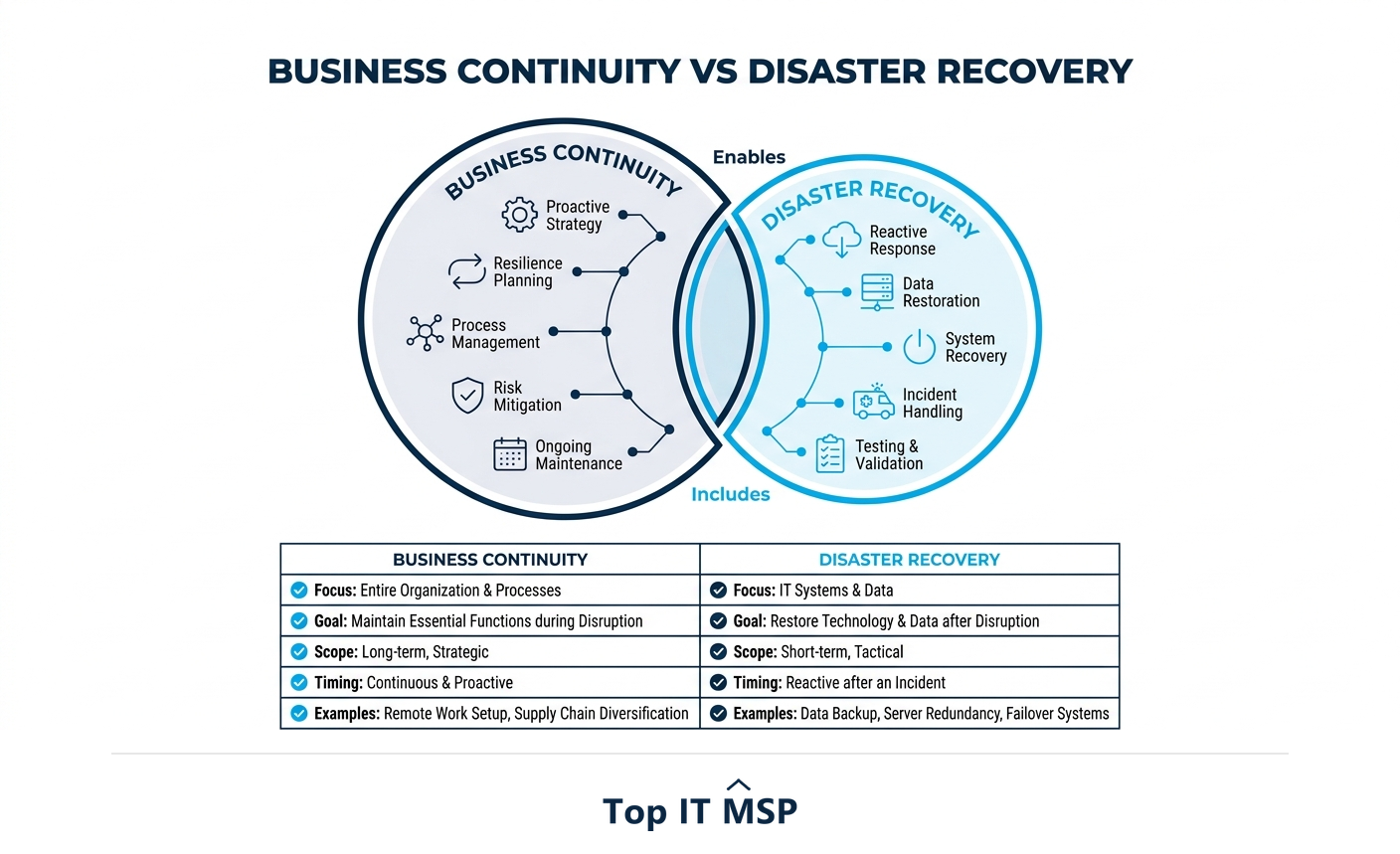
- Disaster recovery restores IT systems and data; business continuity keeps the whole business operating through a disruption.
- Disaster recovery is one component of the broader discipline of business continuity.
- A disaster recovery plan (DRP) is technical; a business continuity plan (BCP) covers people, processes, and operations.
- Modern disaster recovery solutions like cloud DR and DRaaS make fast recovery affordable for any size business.
- You need both: continuity to keep operating and disaster recovery to restore the technology that supports it.
Business continuity vs disaster recovery
Business continuity and disaster recovery are often mentioned in the same breath, and sometimes treated as interchangeable, but they are distinct ideas that work together. Disaster recovery is the IT-focused process of restoring your technology, systems, applications, and data, after an incident. Business continuity is the broader plan for keeping the entire business operating through a disruption, covering not just IT but people, processes, facilities, and communication. The simplest way to hold the distinction: disaster recovery is about getting the technology back; business continuity is about keeping the business running. Disaster recovery is one essential component of business continuity, not a synonym for it. This guide explains the difference, how the two plans relate, and the modern disaster recovery solutions that make resilience achievable for any size of organization.
It pairs with our backup and disaster recovery overview and the managed IT services hub, and builds on our complete guide to backup and disaster recovery.
What is disaster recovery?
Disaster recovery is the set of technologies and procedures for restoring your IT systems and data after a disruptive event, a ransomware attack, server failure, data corruption, or natural disaster. It is fundamentally technical: it answers the question of how you get your servers, applications, and data back online, and how fast. Disaster recovery is measured by two objectives: RTO (recovery time objective), how quickly systems must be restored, and RPO (recovery point objective), how much data you can afford to lose. A good disaster recovery capability rests on solid, tested backups and a documented plan to recover within those targets. It matters enormously because when technology is down, the business is usually down too, and an hour of downtime costs most organizations more than $100,000, while ransomware, which features in about 32% of breaches, can take everything offline at once.
What is business continuity?
Business continuity is the bigger picture. It is the plan for how the whole organization continues to function during and after a disruption, of which an IT outage is only one kind. Business continuity asks: if our office is inaccessible, our systems are down, or key staff are unavailable, how do we keep serving customers, processing orders, paying people, and communicating? It covers alternative work locations, manual workarounds, staff roles and responsibilities during a crisis, supplier and customer communication, and yes, the recovery of IT through disaster recovery. Where disaster recovery is about technology, business continuity is about the entire operation. A business can have excellent disaster recovery, restore its systems quickly, and still fail to operate if it has not planned how people and processes carry on, which is exactly the gap business continuity fills.
How the two relate
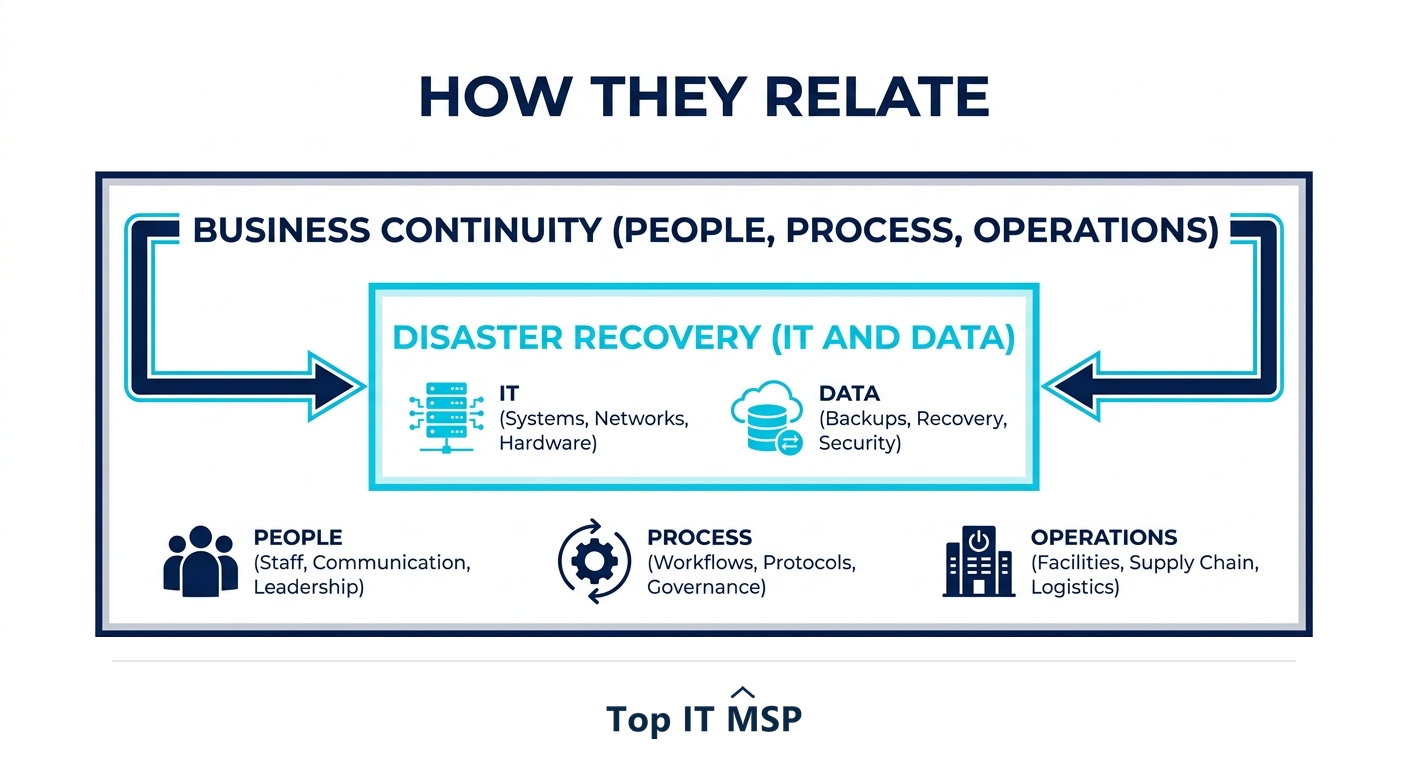
The cleanest way to picture the relationship is as nested circles: business continuity is the large outer circle covering the whole organization's ability to keep operating, and disaster recovery is a smaller circle inside it, focused specifically on restoring IT. You cannot have effective business continuity without disaster recovery, because modern operations depend on technology, but disaster recovery alone is not enough, because restoring servers does not automatically keep the business running. They are complementary: disaster recovery brings the technology back, and business continuity ensures the organization keeps functioning while that happens and afterward. Treating them as one, or doing only the technical half, is a common and dangerous mistake, especially since breaches take an average of 258 days to identify and contain and a disruption can stretch on far longer than expected.
BCP and DRP: the two plans
The distinction shows up most clearly in the documents. A disaster recovery plan (DRP) is technical: it lists critical systems, their RTO and RPO, the recovery steps, where backups live, and who performs the restore. A business continuity plan (BCP) is broader: it identifies the business's essential functions, the impact of losing them, the workarounds and alternative arrangements to keep them going, the crisis communication approach, and the roles people play during a disruption, with the DRP nested inside it for the IT piece. Both plans share a non-negotiable requirement: they must be tested. A plan that has never been rehearsed tends to fail under the stress of a real event, when systems are down and people are improvising. Regular testing, and using automation, which saves breached organizations an average of $2.22 million, is what turns documents into genuine resilience.
Modern disaster recovery solutions
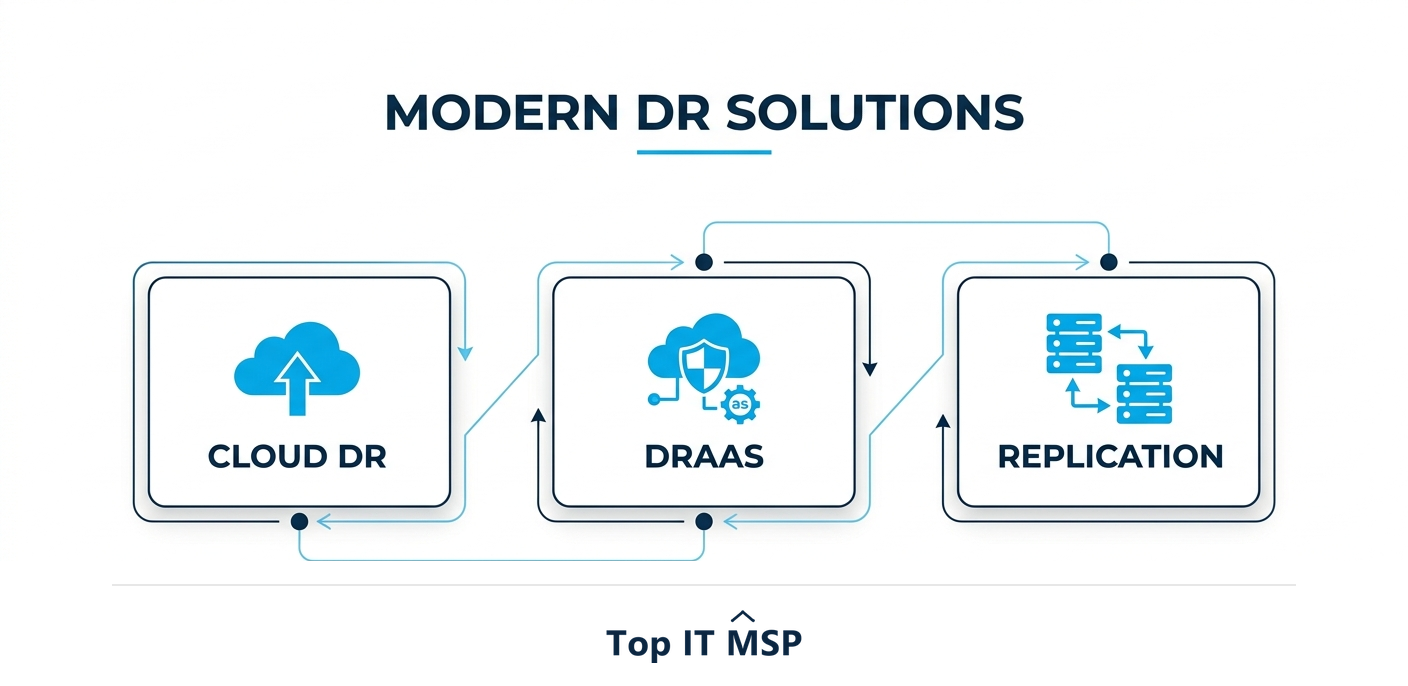
What was once expensive and complex, maintaining a duplicate data center for failover, is now affordable thanks to the cloud. Modern disaster recovery solutions put enterprise-grade recovery within reach of any business:
- Cloud disaster recovery. Replicating systems and data to the cloud, so you can fail over and run from the cloud if your primary environment goes down, without owning a second data center.
- Disaster-recovery-as-a-service (DRaaS). A managed provider runs your disaster recovery for you, replicating your environment and handling failover and recovery, often the simplest path to a low RTO.
- Replication and standby systems. Continuous, ongoing copying of data and systems to a redundant standby environment so recovery is measured in minutes, not days.
- Immutable, isolated backups. Backups that ransomware cannot reach or encrypt, ensuring you always have a clean copy to restore.
These solutions let a small business achieve recovery objectives that once required an enterprise budget, which is part of why the managed services market is growing from about $330 billion in 2024 toward $879 billion over the next decade.
The cost of getting it wrong
Skimping on either continuity or recovery is a gamble against odds that catch up with most businesses eventually. A company with neither faces the worst case when disaster strikes: systems down with no fast path back, no plan for how people keep working, mounting downtime at more than $100,000 an hour, and the very real risk of a breach, the average costs $4.88 million, turning into a closure. Even a company with good disaster recovery but no business continuity can restore its servers and still grind to a halt because no one planned how operations carry on. The shortage of expertise to do this well, amid a global shortfall of about 4.8 million cybersecurity professionals, makes it harder to build alone, and organizations facing a security skills shortage saw breach costs about $1.76 million higher. The encouraging reality is that affordable modern solutions and a sound plan put genuine resilience within reach, and the cost of preparation is trivial next to the cost of an unmanaged disaster.
Getting both right
Business continuity and disaster recovery are not competing choices; they are two halves of resilience, and you need both. Disaster recovery restores the technology your business runs on, fast and reliably, while business continuity ensures the organization keeps serving customers and operating throughout. Build a tested disaster recovery plan with clear RTO and RPO and modern solutions like cloud DR or DRaaS, wrap it in a business continuity plan that covers people, processes, and communication, and test both regularly. Do that and a disruption that would close an unprepared competitor becomes, for you, a manageable interruption. The aim is a resilient, reliable business backed by redundant systems and continuous protection that protect operations no matter what hits, because the human element is involved in 68% of breaches and trouble rarely announces itself in advance.
If you want help building business continuity and disaster recovery solutions, comparing vetted providers on merit is the place to start. Browse merit-ranked managed IT firms by city in the Top IT MSP directory, where ranking is earned on rating and verified data, not on who pays the most. You can also read our complete guide to backup and disaster recovery.
Frequently asked questions
What is the difference between business continuity and disaster recovery?
Disaster recovery is the IT-focused process of restoring systems and data after an incident, answering how fast you get technology back online. Business continuity is the broader plan for keeping the whole business operating through a disruption, covering people, processes, facilities, and communication, not just IT. Disaster recovery is the technology half; business continuity is the entire operation, with disaster recovery nested inside it.
Is disaster recovery part of business continuity?
Yes. Disaster recovery is one essential component of business continuity, not a synonym for it. Picture nested circles: business continuity is the large outer circle covering the organization's ability to keep operating, and disaster recovery is a smaller circle inside, focused on restoring IT. You cannot have effective business continuity without disaster recovery, but disaster recovery alone does not keep the business running.
What is the difference between a BCP and a DRP?
A disaster recovery plan (DRP) is technical: it lists critical systems, their RTO and RPO, recovery steps, where backups live, and who performs the restore. A business continuity plan (BCP) is broader: it identifies essential business functions, the impact of losing them, workarounds and alternative arrangements, crisis communication, and people's roles, with the DRP nested inside it for the IT piece.
What are modern disaster recovery solutions?
Modern disaster recovery solutions include cloud disaster recovery (replicating systems and data to the cloud for failover), disaster-recovery-as-a-service (DRaaS, where a provider runs your DR and handles failover), replication to standby systems for near-instant recovery, and immutable, isolated backups that ransomware cannot reach. They make enterprise-grade recovery affordable for businesses of any size.
What is DRaaS?
DRaaS, or disaster-recovery-as-a-service, is a model where a managed provider runs your disaster recovery for you, continuously replicating your environment and handling failover and recovery when an incident occurs. It is often the simplest way for a business to achieve a low recovery time objective without building and maintaining its own secondary data center, delivering enterprise-grade recovery as a subscription.
Do I need both business continuity and disaster recovery?
Yes. They are two halves of resilience. Disaster recovery restores the technology your business depends on, while business continuity ensures the organization keeps serving customers and operating throughout a disruption. A business with good disaster recovery but no continuity plan can restore its servers and still grind to a halt because no one planned how people and processes carry on. You need both.
Related reading
Build resilience that keeps you running
Top IT MSP is the independent directory of vetted managed IT providers across North America. Compare merit-ranked firms in your city that build business continuity and disaster recovery solutions. No pay-to-play.
Top IT MSP is an independent directory that connects you with vetted managed IT providers. Browse the directory city by city:
- Managed IT Services in Atlanta
- Managed IT Services in Philadelphia
- Managed IT Services in New York
- Managed IT Services in Los Angeles
- Managed IT Services in Orlando
- Managed IT Services in Ottawa
- Managed IT Services in Pasadena
- Managed IT Services in Pensacola
- Managed IT Services in Pittsburgh
- Managed IT Services in Plano