Colocation vs Cloud: Where Should Your Data Center Live?
Colocation means renting space in a professional data center to house servers you own and control, while cloud means renting computing from a provider with no hardware of your own. Colocation gives you control, predictable cost, and enterprise-grade facilities while you keep your equipment; cloud gives you on-demand scalability and no hardware to manage. Colocation suits stable, hardware-heavy, or compliance-driven workloads; cloud suits variable or fast-growing ones. Many businesses run a hybrid of both, and either way the servers still need active management.
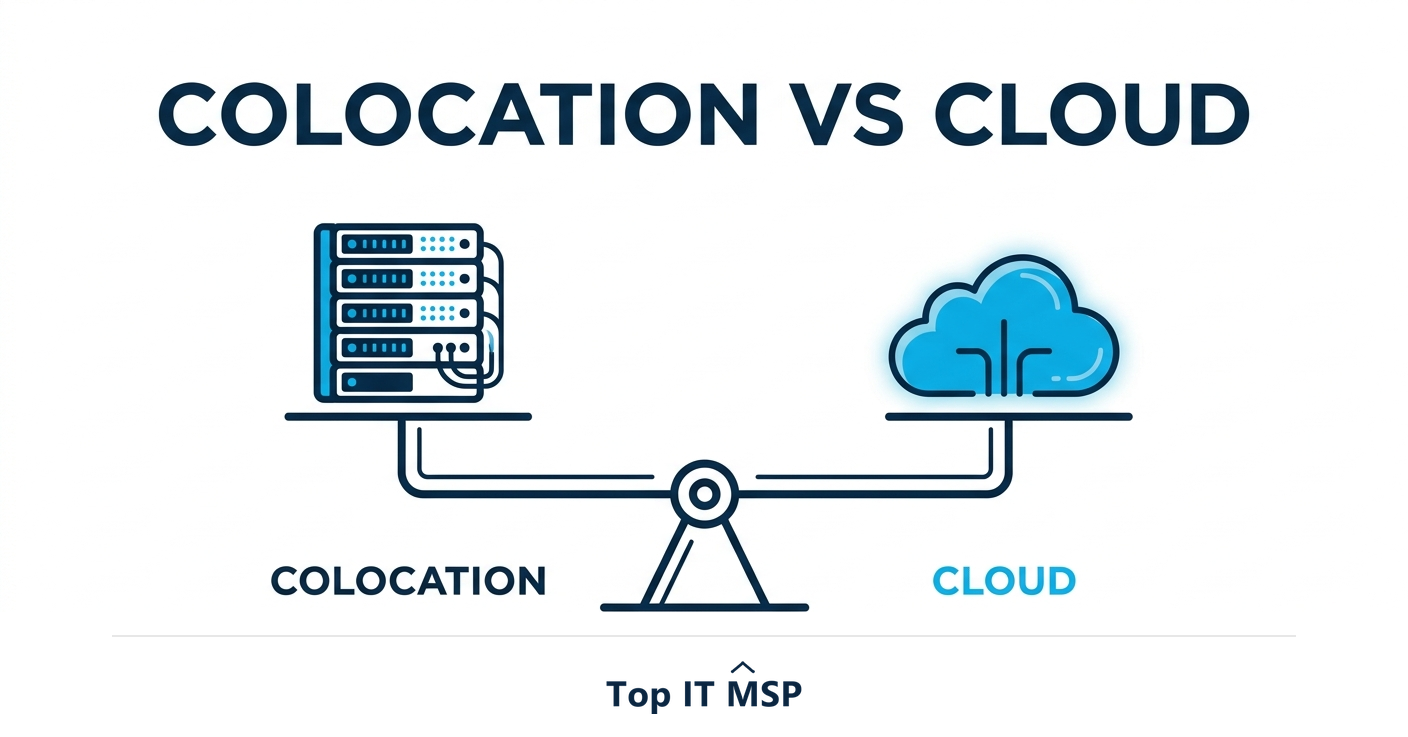
- Colocation houses servers you own in a professional data center; cloud rents computing with no hardware of your own.
- Colocation offers control, predictable cost, and enterprise facilities; cloud offers on-demand scalability.
- Colocation suits stable, hardware-heavy, or compliance-driven workloads.
- Cloud suits variable, fast-growing, or unpredictable workloads where elasticity matters most.
- Many businesses run a hybrid of both, and in every case the servers still need active management.
Colocation vs cloud: the question
When a business outgrows the server closet, it faces a strategic question: where should its servers and data actually live? Two answers dominate. Colocation means renting space, power, cooling, and connectivity in a professional data center to house servers you own and control. Cloud means renting computing power and storage from a provider like AWS or Azure, with no hardware of your own. Both get your infrastructure out of an inadequate office room and into a resilient, professionally run environment, but they do so in very different ways with very different trade-offs. With public cloud spending forecast to reach $723.4 billion in 2025 and 89% of organizations running a multi-cloud strategy, the cloud gets the headlines, but colocation remains the right answer for many workloads.
This guide compares data center colocation services and cloud on the factors that matter, control, cost, scalability, and maintenance, and explains when each wins and why hybrid is so common. It pairs with our server and data center support overview and the cloud services hub.
What is data center colocation?
Colocation, often shortened to colo, is a service where you place your own servers and networking equipment in a third-party data center. You own and control the hardware; the colocation provider supplies the building blocks that are hard and expensive to run yourself: redundant power with backup generators, industrial cooling, multiple high-speed internet connections, and physical security. Crucially, colocation gives you enterprise-grade facilities, including the redundancy that delivers high uptime, without building your own data center. You keep full control over your equipment, operating systems, and configurations, and you can host whatever you like on hardware you have specified. Data center colocation services typically charge based on the space and power you use, which makes cost predictable.
What is the cloud?
The cloud takes a different approach: you own no hardware at all. Instead, you rent virtual servers, storage, and services from a provider that owns and operates massive data centers, and you pay for what you use. The provider handles all the physical infrastructure and the hardware layer, while you manage the operating systems, applications, and data you run on it. The defining advantages are a scalable, elastic model, scaling capacity up or down on demand, and the absence of any hardware to buy or maintain. The trade-off is less direct control over the underlying environment, usage-based costs that can be less predictable, and ongoing responsibility to secure and configure what you run, since most cloud failures trace to customer mistakes.
The comparison: control, cost, scalability, maintenance
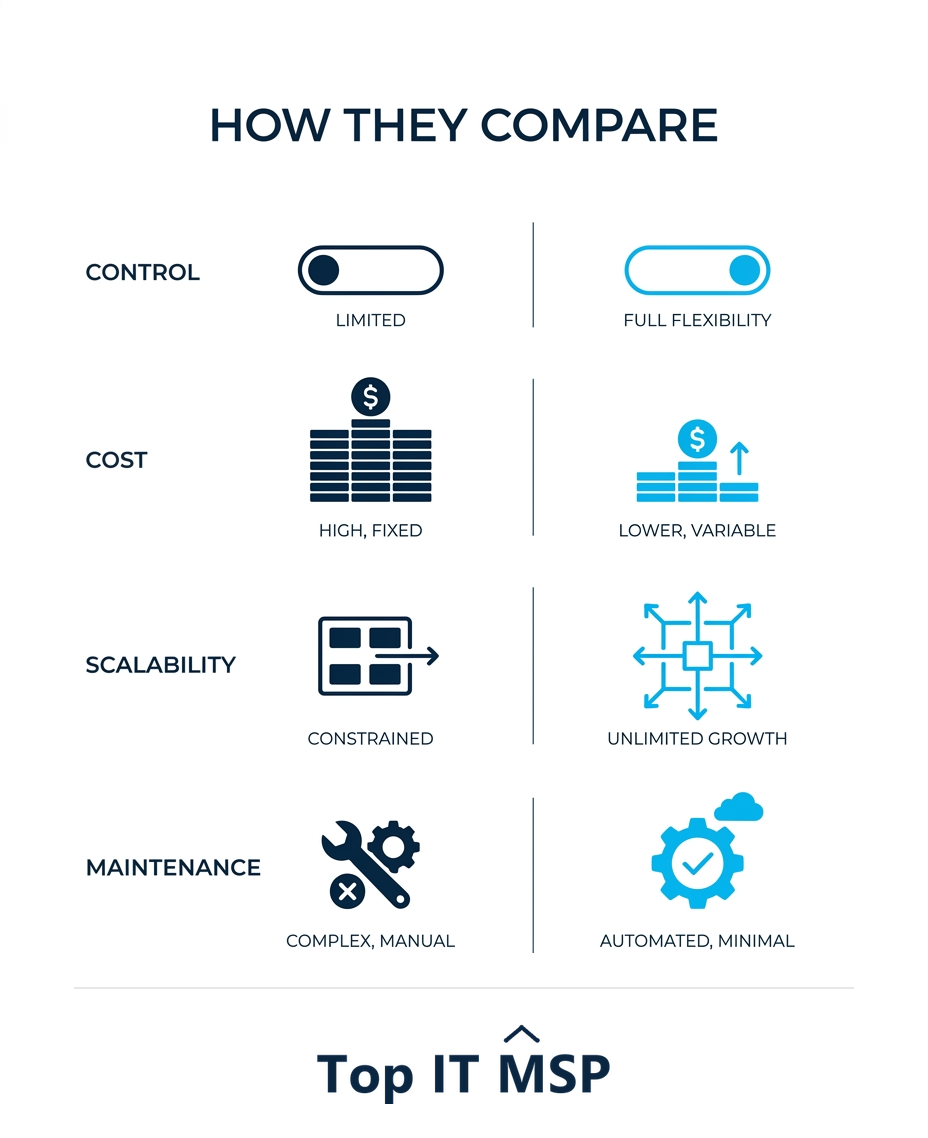
Four factors usually decide it. Control: colocation gives you full control of your own hardware and configuration; the cloud abstracts that away. Cost: colocation is a more predictable, capital-and-flat-fee model, while the cloud is usage-based, which can be cheaper for variable demand but can also balloon if unmanaged. Scalability: the cloud wins decisively, scaling in minutes, where colocation requires buying and installing more hardware. Maintenance: in the cloud the provider maintains the hardware; in colocation you still own and maintain your servers, though the facility handles power, cooling, and connectivity. Both deliver far better uptime than an office server room, and both still leave you responsible for managing your servers, an outage costs most organizations more than $100,000 an hour regardless of where the server sits.
When colocation makes sense, and when cloud does
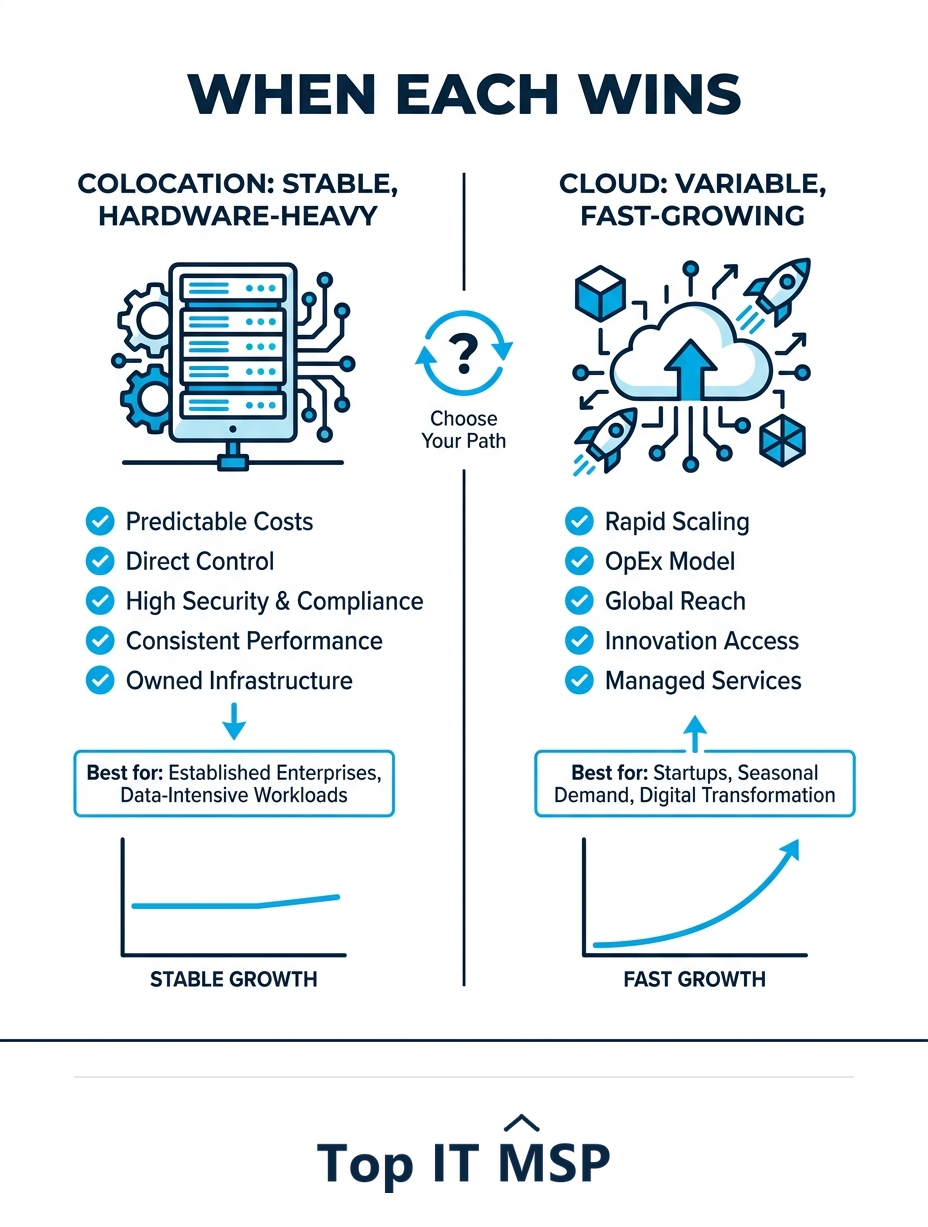
Colocation tends to win when you already own significant hardware you want to keep using, when your workloads are stable and predictable so usage-based cloud pricing offers no advantage, when you need full control for performance or specialized configurations, or when compliance and data-residency requirements make owning your equipment in a known location simpler. Cloud tends to win when demand is variable or growing fast and you need elasticity, when you want to avoid capital expenditure and hardware management entirely, or when you are building modern, cloud-native applications. Security matters in both: the average breach costs $4.88 million and takes an average of 258 days to identify and contain, and in the cloud specifically Gartner projects 99% of cloud security failures are the customer's fault, so configuration discipline is essential wherever you land.
The hybrid reality
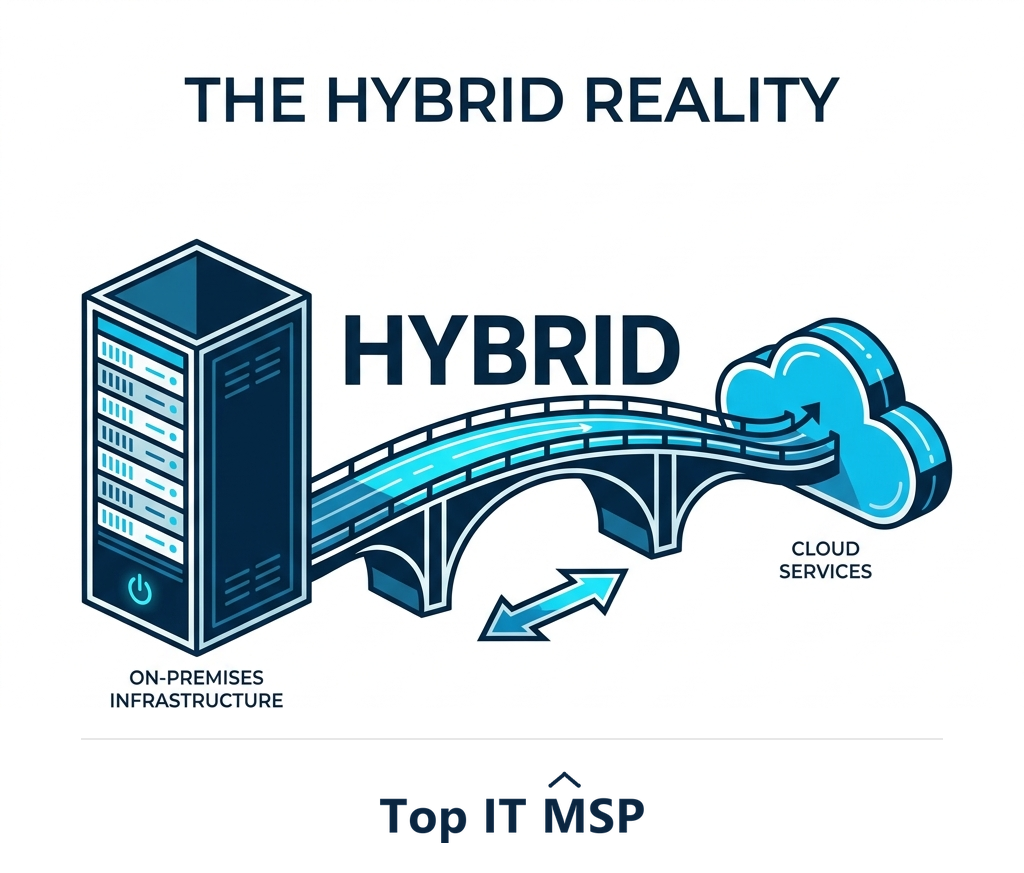
In practice, the choice is rarely all-or-nothing. Most growing businesses end up running a hybrid: keeping stable, hardware-heavy, or compliance-sensitive workloads in colocation while choosing to migrate variable, customer-facing, or fast-scaling workloads to the cloud where elasticity pays off. This lets you place each workload where it fits best, predictable systems on owned hardware in a resilient facility, elastic systems in the cloud, rather than forcing everything into one model. The complexity of running both well, networking them together, securing them, and managing the servers across both, is real, which is part of why the managed services market is growing from about $330 billion in 2024 toward $879 billion over the next decade. Whichever mix you choose, the servers and data still need active, ongoing management.
Getting the decision right
There is no universally correct answer to colocation versus cloud; there is only the right fit for each workload. Map your systems honestly: how stable is the demand, how much control do you need, what does compliance require, and what is the true cost of each option over time? Stable and controlled tends to favor colocation; variable and elastic tends to favor cloud; and a thoughtful hybrid often beats either alone. The key is to decide deliberately rather than defaulting to whatever seems fashionable, and to keep whatever you run actively managed and secured, because the location of a server matters far less than the discipline with which it is operated.
If you are weighing data center colocation services, cloud, or a hybrid, comparing vetted providers on merit is the place to start. Browse merit-ranked managed IT firms by city in the Top IT MSP directory, where ranking is earned on rating and verified data, not on who pays the most. You can also read our guide to data center migration.
Frequently asked questions
What is the difference between colocation and cloud?
Colocation means renting space, power, cooling, connectivity, and physical security in a professional data center to house servers you own and control. Cloud means renting virtual computing and storage from a provider with no hardware of your own. Colocation gives you control and predictable cost while you keep your equipment; cloud gives you on-demand scalability and no hardware to maintain.
What are data center colocation services?
Data center colocation services let you place your own servers and networking equipment in a third-party data center that supplies redundant power, industrial cooling, high-speed connectivity, and physical security. You own and control the hardware and what runs on it, while the provider supplies the resilient facility, typically charging based on the space and power you use.
Is the cloud cheaper than colocation?
It depends on the workload. The cloud's usage-based pricing can be cheaper for variable or unpredictable demand because you pay only for what you use, but it can also balloon if left unmanaged. Colocation offers a more predictable, flat-fee model that often costs less for stable, steady workloads, especially if you already own the hardware. Total cost over time is what matters.
When should a business choose colocation over cloud?
Colocation tends to win when you already own significant hardware you want to keep using, when workloads are stable and predictable, when you need full control for performance or specialized configurations, or when compliance and data-residency requirements make owning your equipment in a known location simpler. Cloud tends to win for variable, fast-growing workloads needing elasticity.
Can you use both colocation and cloud?
Yes, and many businesses do. A hybrid approach keeps stable, hardware-heavy, or compliance-sensitive workloads in colocation while putting variable, customer-facing, or fast-scaling workloads in the cloud, placing each where it fits best. The trade-off is the added complexity of networking, securing, and managing servers across both environments, which is why many use a managed provider.
Do colocated and cloud servers still need management?
Yes. Neither model removes the need to manage your servers. In colocation you own and maintain the hardware while the facility handles power, cooling, and connectivity. In the cloud the provider handles the hardware, but you still manage, patch, secure, and back up the operating systems and applications you run. Both still require active, ongoing server management.
Related reading
Decide where your data center should live
Top IT MSP is the independent directory of vetted managed IT providers across North America. Compare merit-ranked firms in your city that handle colocation, cloud, and hybrid infrastructure. No pay-to-play.
Top IT MSP is an independent directory that connects you with vetted managed IT providers. Browse the directory city by city:
- Managed IT Services in Chicago
- Managed IT Services in Houston
- Managed IT Services in Dallas
- Managed IT Services in Phoenix
- Managed IT Services in Grand Rapids
- Managed IT Services in Greensboro
- Managed IT Services in Greenville
- Managed IT Services in Hamilton
- Managed IT Services in Huntington Beach
- Managed IT Services in Indianapolis